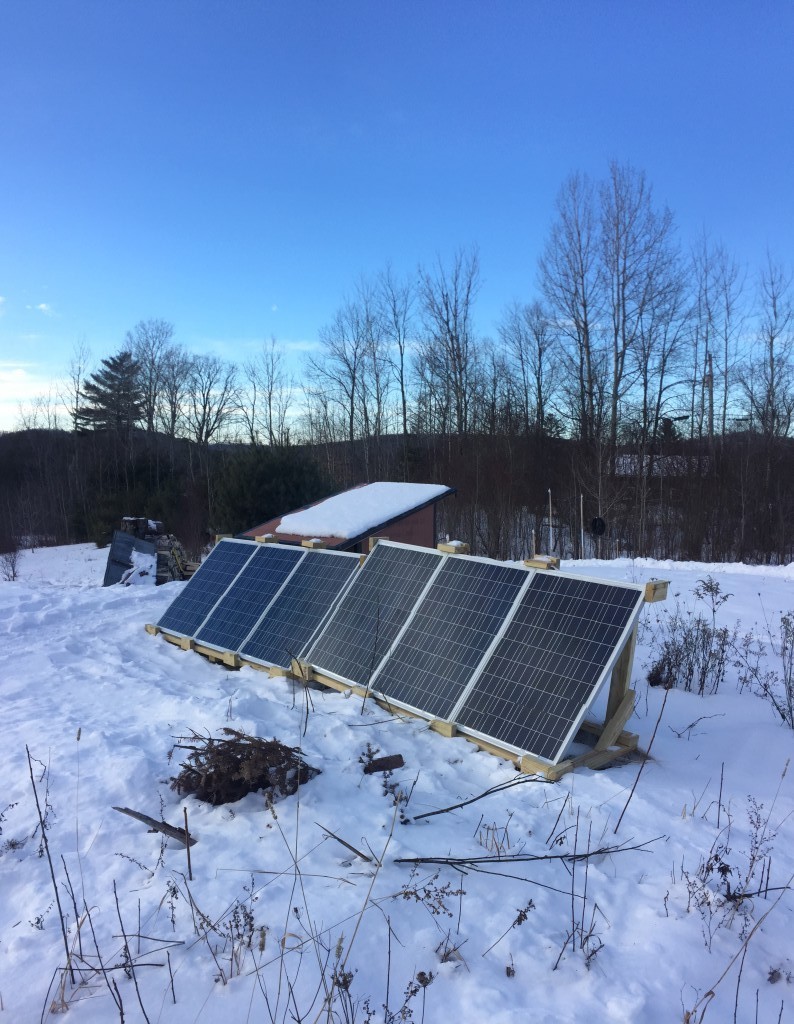
Just found that out, this is starting to be a very expensive lightning strike.
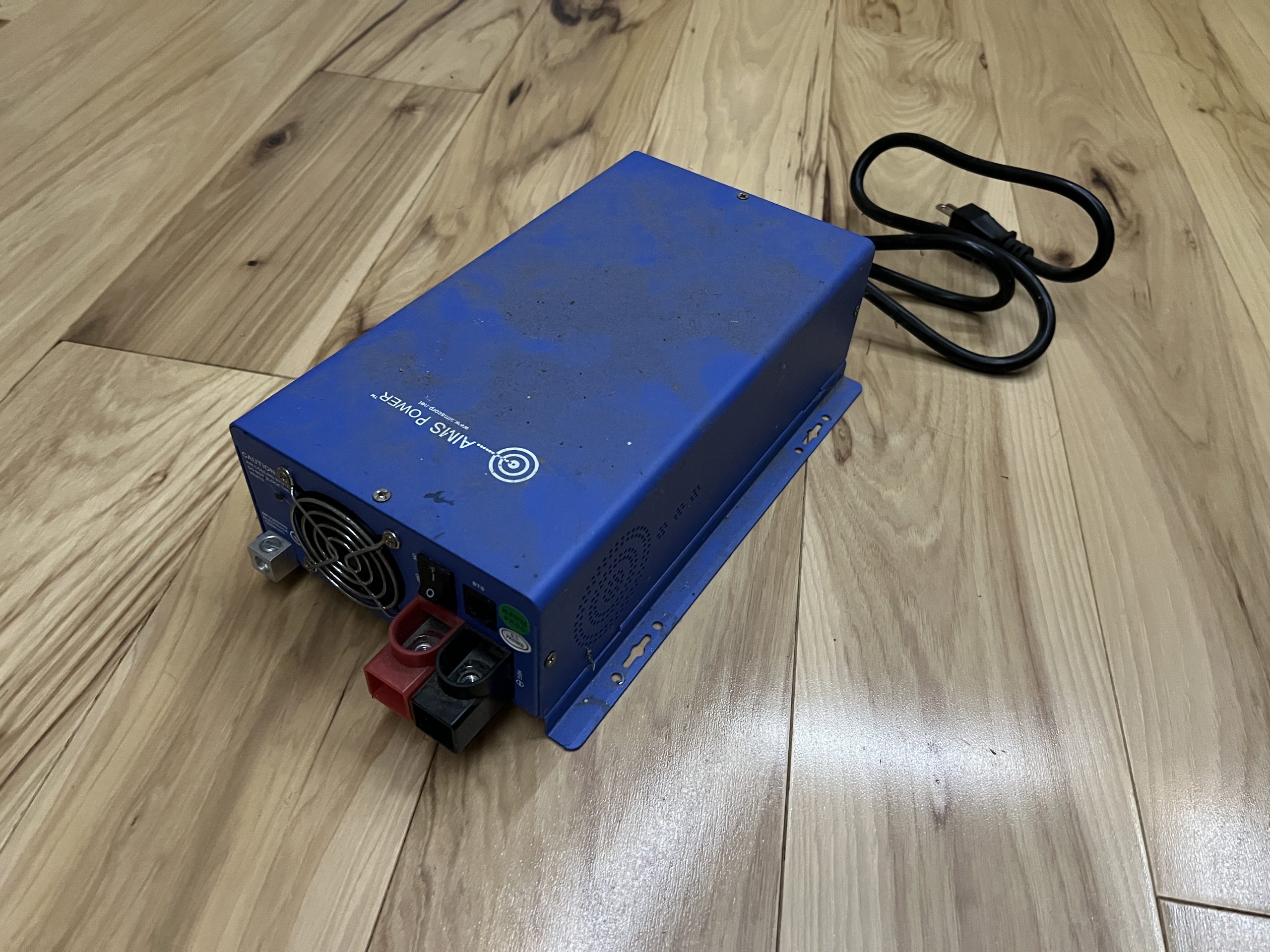
Just found that out, this is starting to be a very expensive lightning strike.
I lost a voltage sensor the exact minute thunder struck very close to the house, Nicole happened to be filming because it was an impressive mix of rain, hail & thunder. Does thunder create some sort of EMP? Could be a coincidence but the timing is really suspicious. Sorry I mean sus.
dead sensor :\

Oh, well I’ll just buy a replacement.

And fuck, I forgot we screw over allies and suck up to dictators now. Phidgets come from Canada, I never found any comparable alternatives in the realm of current sensing that goes beyond small hobbyist projects. And I don’t really want to relearn/recode a whole new deal anyway. I just want replacement parts.
Extensive searching pointed to robotshop.com having Phidgets parts in stock. So I grabbed spares for everything to get a few thunderstrikes ahead and buy me a few years. For the top 3 parts, I grabbed everything they are left.

The battery voltage sensor is actually important these days as automation uses it to make decisions on which circuits to turn on/off. So for a few days until I got the part, I moved the panels’ voltage sensor to the battery. Sensing the panels is informational and has no real consequence on function. With anything solar, I have appreciated having spares at hand so it was time to spend some money and make that true for the monitoring side of things which we became more dependent on over time.
Solar battery degradation always happens slowly enough that I don’t realize how bad things have become. And as soon as I talk about replacing batteries, they know and completely give up on me.
For my first battery bank, I got AGM batteries which were nice but didn’t last as long as I thought they would. I liked that they were sealed and didn’t require maintenance, it was a good beginner choice.
When they died, I replaced them with more standard Flooded Lead Acid. They seem to be much most common around off griders in the area. In talking with them, they related many years of service for theirs. I figured I knew enough then, and I’d maintain them to prolong their lifetime. So I got Flooded Lead Acid for my next generation.
Well, I kept them only about 2.5 years and now they are very much toast. A friend of mine just got Lithium batteries, and since I was due for a replacement, I delved into it to see if it would be a good idea. Last I checked they were way more expensive per Ah (Amp hour), and I was a little suspicious of lithium having experienced its instability in small electronics batteries.
Turns out, while the price per Ah is indeed much more for Lithium, the price per Ah per cycle is about 5 times less. And in our case, we very much cycle our batteries. We don’t have a turbine to keep them charged 24/7. They have so many advantages I feel stupid I didn’t switch earlier. It’s always difficult to question established wisdom, especially from a place of ignorance. As far as I can tell Lithium batteries have the following advantages:
Some of these I can attest to already, the longevity ones remain to be seen.
So I replaced 5 lead acid batteries with 3 lithium ones, and the difference is night and day. But given how far gone they were, it would be true with anything.
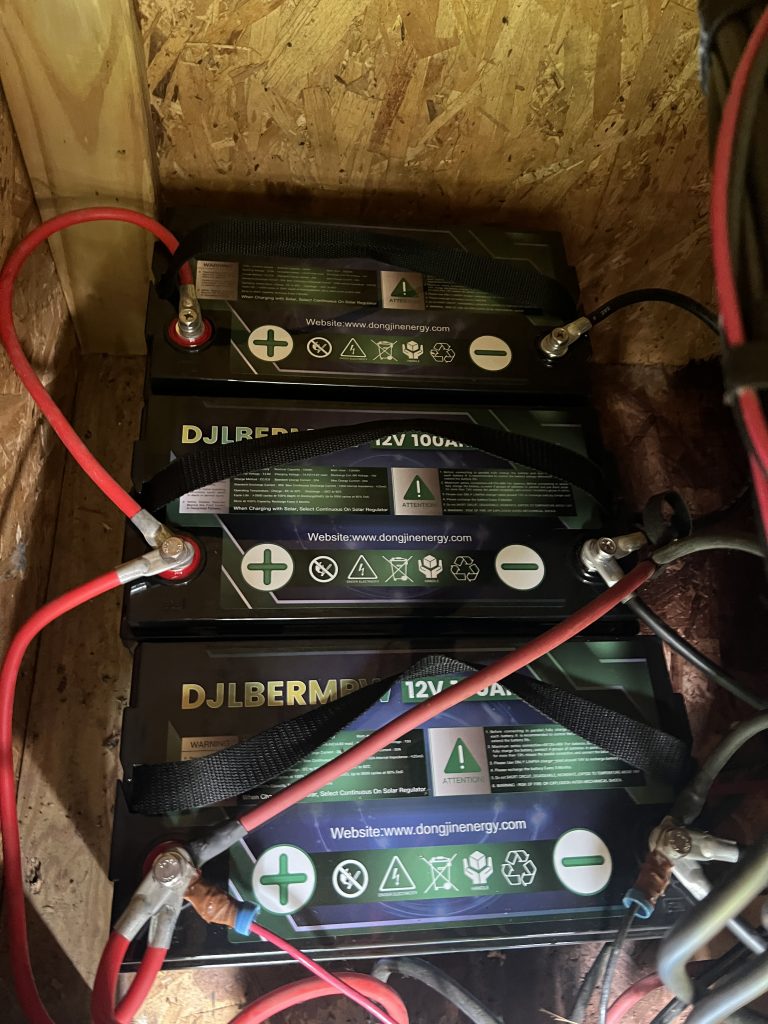
I am definitely a bit more worried about the result of a failure. However, years ago I put all the electrical stuff in a shed detached from the house. I had no idea what I was doing with anything electrical and figured if I must set something on fire, it might as well not be the house. Today I’m still happy with the decision. Last Summer a house burnt down and people died in a neighboring village from a power tool battery charger which kept charging a Lithium battery. These are usually around 4Ah, you can imagine 3*100Ah would definitely set stuff on fire. I’ve been worried about all the small electronics we have in the house with their own Lithium batteries and probably a single sensor deciding if they should keep getting charged or not. Sensors fail. In any case, I’m happy to have these new batteries which promise to make my life easier, and to have them away from the house :).
My charge controller was rated for Lithium batteries, but it turns out that wasn’t true out of the box. Lithium technology is still new enough that not everything comes ready for it. Switching it over was, like too many things in life these days, a computer nightmare. Serial communication, bad software, bad translation, and no documentation. Even though I understand things better these days, I’m still baffled by how disparate information is about anything solar.
On the money front, these guys set me back $784. It’s pricey but nothing compared to years of electric bills. Our solar system has paid for itself a couple of time over, and only the batteries come with a recurring cost every few years.
Lastly I’m happy and eager to keep learning about all this, I’ve come a long way since the beginning. This understanding ties into electronics projects. Nicole got an electric lawnmower recently, and the ultimate goal is of course an electric car. I’m still working on scaling up, and improving processes and automation to get there. I can’t wait for the day where this solar array is my gas station.
I lost the solar monitoring for a few days. While I do have a backup for everything that gets us electricity, I don’t have a backup of the monitoring system. And I’ve gotten real used to watching these graphs. It’s very much second nature these days, much like keeping an eye on the weather to adjust your day.
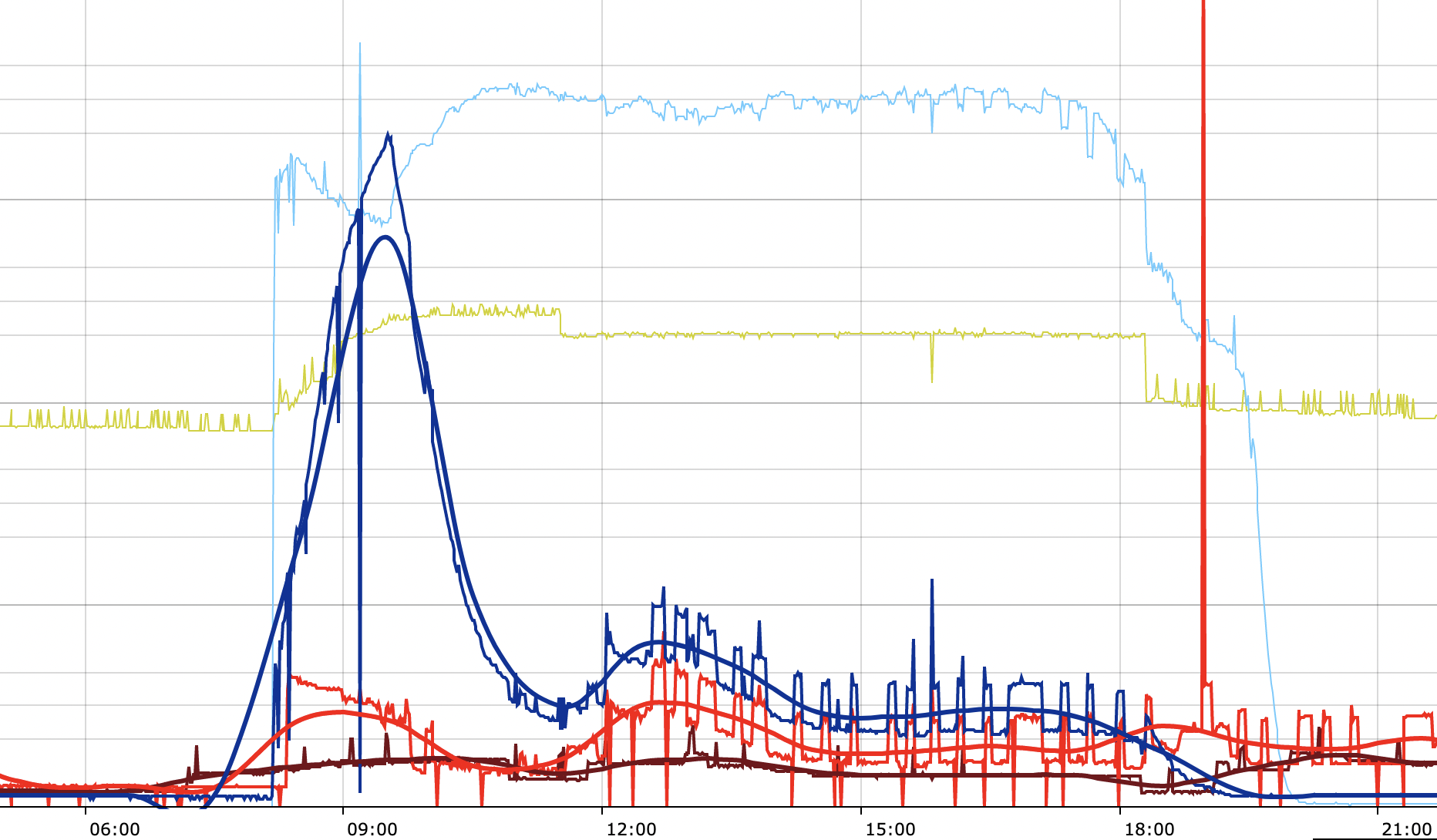
On top of this, I have scripts that will turn on and off the inverter based on that monitoring data. It makes my life easier for automation to keep watch and make decisions. And so for a few days, I was flying blind. Well not entirely, I still had the one voltage indicator with busted segments.
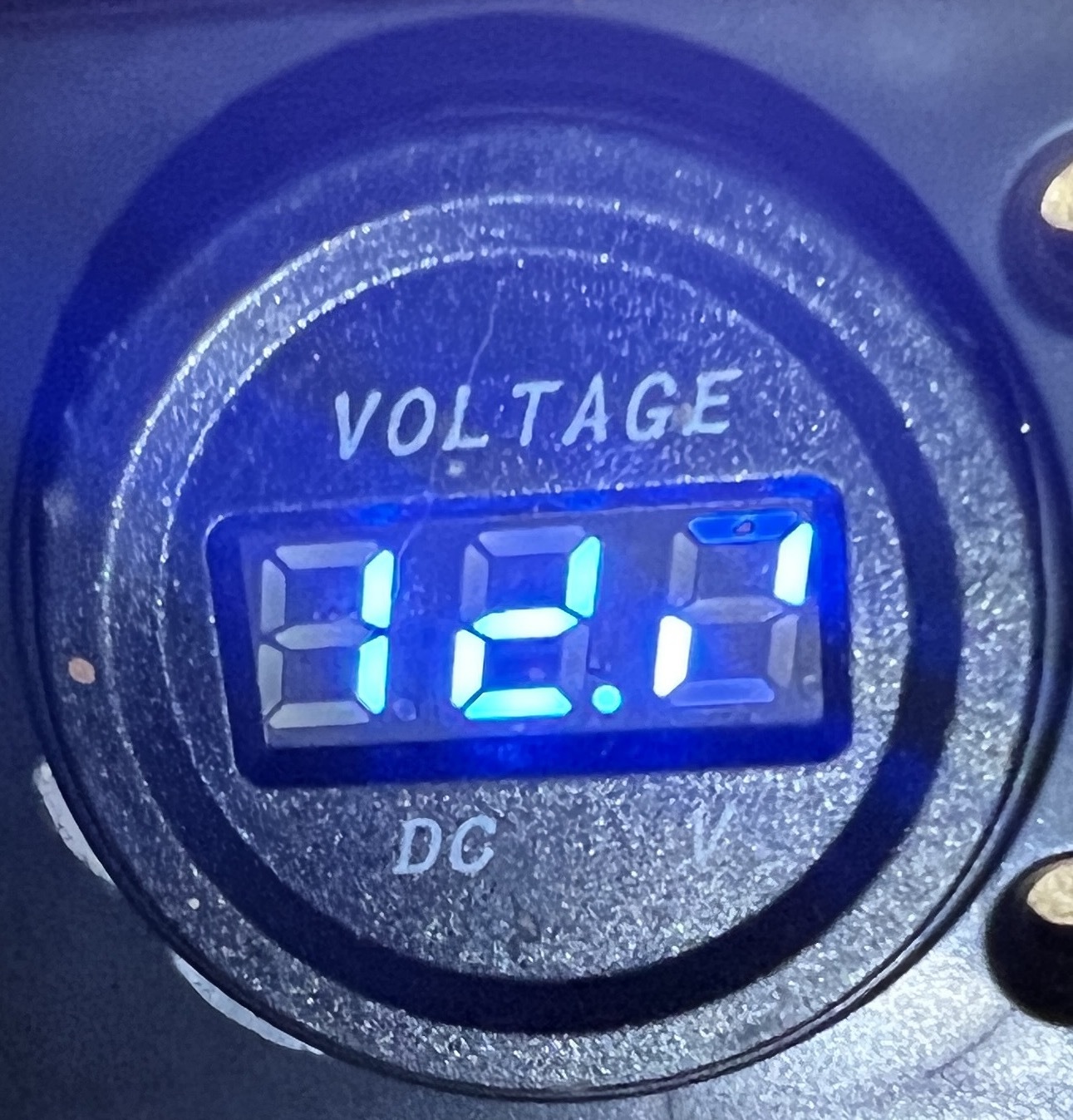
And really it’s not too bad, I’m so much better today at knowing where things are and where’s they’re headed with just that information. But I still missed the automated decision making.
Anyway, this Phidget part is busted, and it took a few days to get another one from Canada.
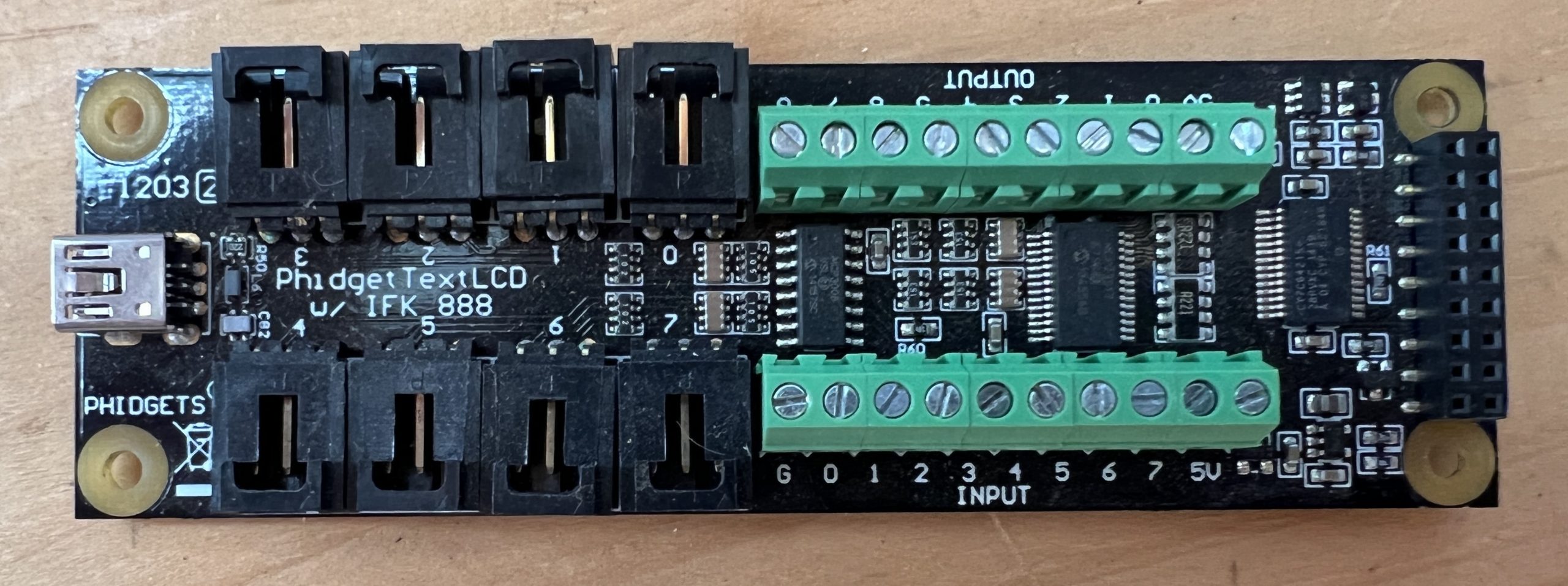
I might have to get an extra for backup, but they’re pretty pricey. The previous one lasted 7 years, and died for no particular reason, having gathered 16,719,281 data points. It’s a bit of a shame, and my readings are a bit off now, I’ll likely have to recalibrate the sensors.
For a couple of days, we struggled to keep batteries charged even though Sun was plentiful. Quick investigation revealed the charge controller taking pauses for no apparent reason.
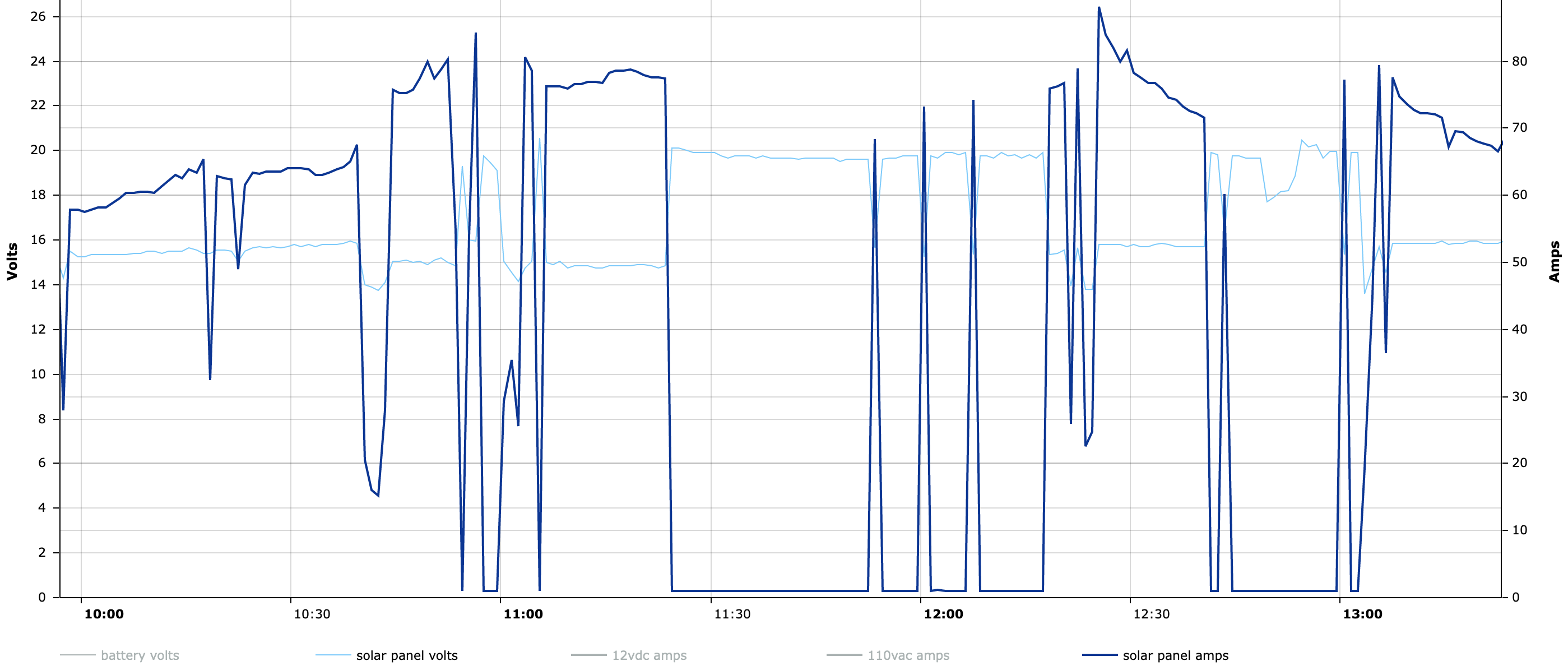
I looked at the charge controller’s screen which had some sort of fault, the manual wasn’t particularly helpful but the screen did show that the battery temperature sensor was reporting 67°C, which was absurd (and checked by hand).
The culprit was the sensor, which held against the batteries inevitably got acid water splashed on while refilling the batteries.
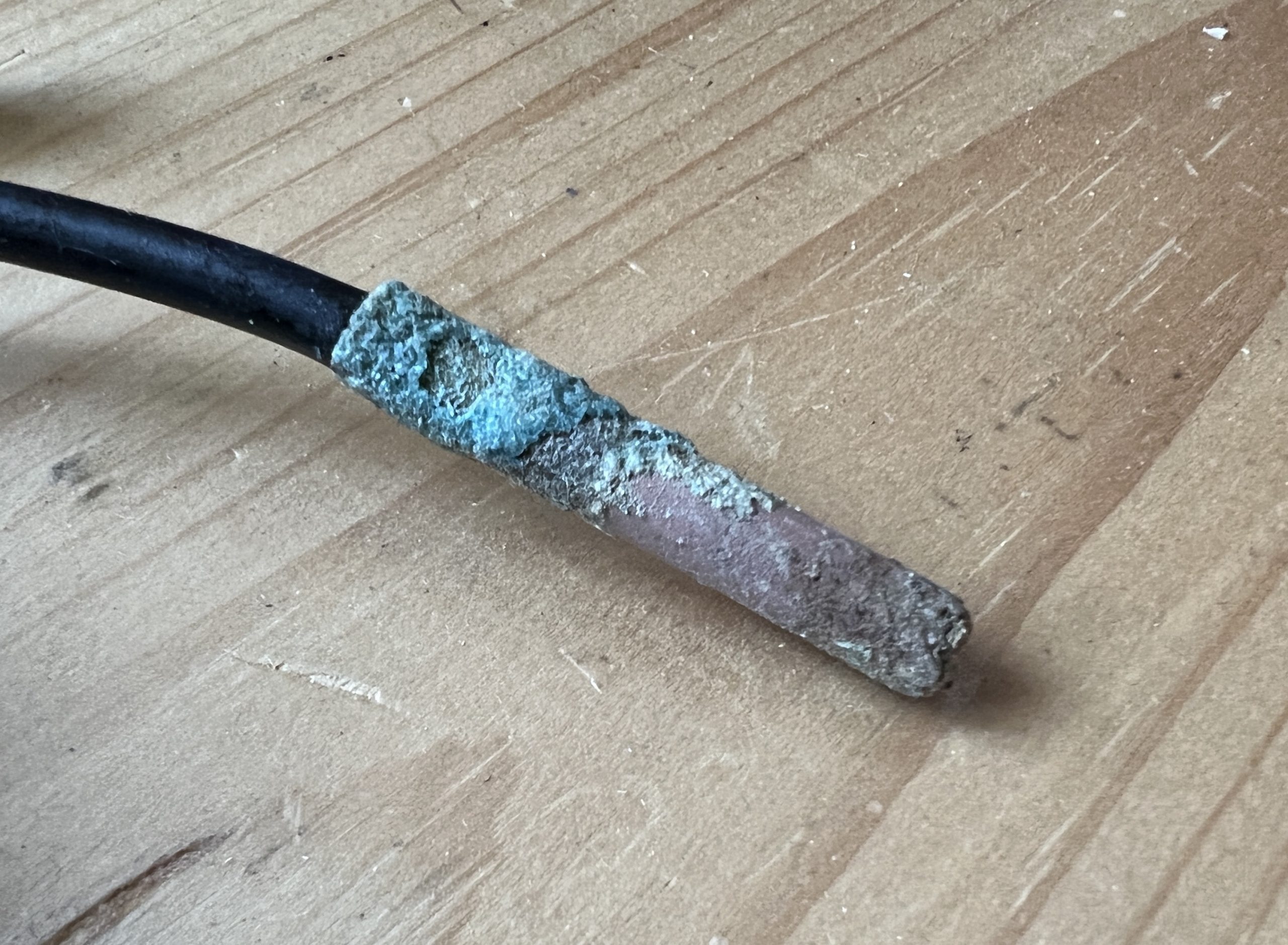
The charge controller does not need to know the battery temperature, but it is better for charging decisions and fault protection. So it can simply be unplugged for a bit, but also… I actually have been slowly accumulating double our solar setup, 18 more panels, 1 more charge controller, 1 more inverter, and all the bits and pieces to put them together. We are slowly getting our ducks in a row for an electric car and this currently not deployed expansion is for it. In any case, I just grabbed the sensor from the extra charge controller and plugged it in and ordered another one. It’s nice to have backups of everything too :).
I also added to the monitoring script so it would bark if no amps were coming in during day hours, this really should never be the case.
Megadouche is back in business, it has been since early April. We’ve learned that we can deploy it early and get some use regardless of small frosts. We have it for almost half the the year now and its deployment is cause for huge celebration. The kids are very excited about it.
It comes with several major improvements this year too, I’m not sure we’ll be able to top that.
Bigger tankless heater
This guy can heat double the amount of water the previous one could at 3.2 Gallons per minute.
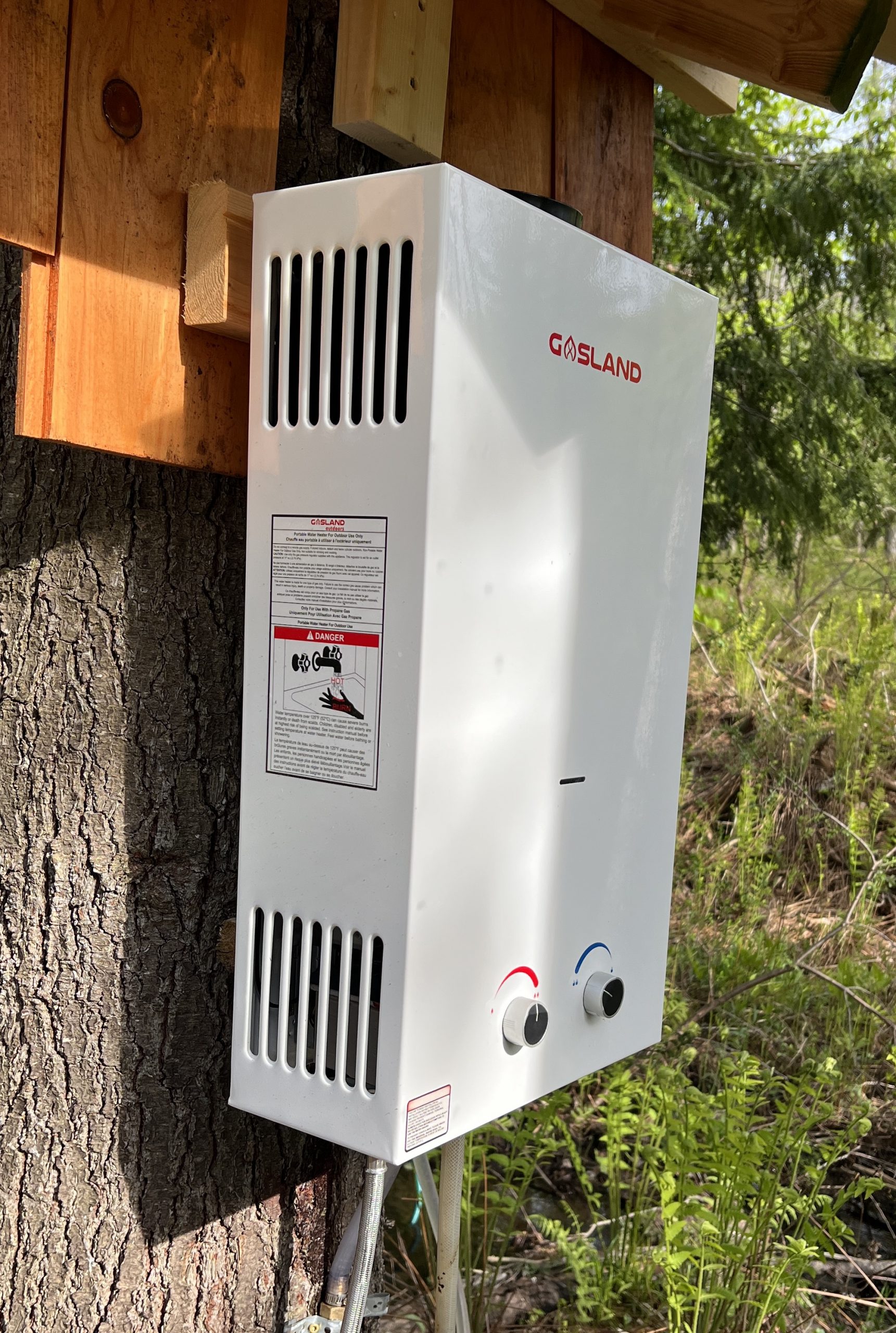
Bigger pump, bigger shower head to go through all this water, and a better platform to step on

Output Switch
We now have a choice between the shower head and a longer hose that can reach places like the tub or laundry spot.
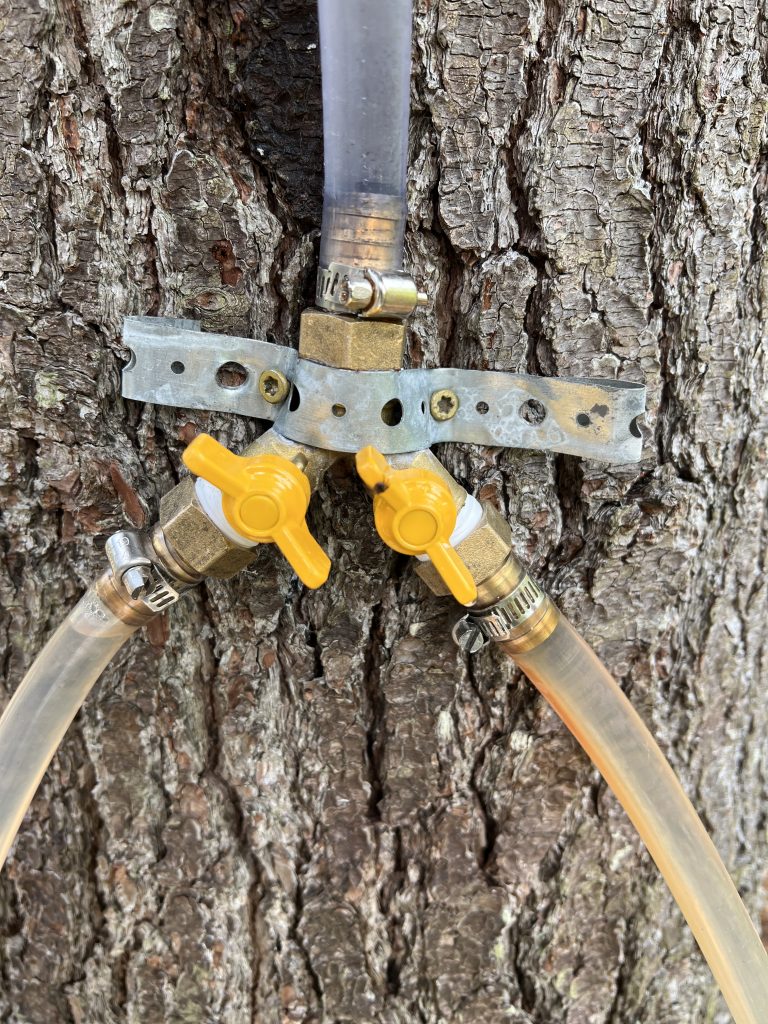
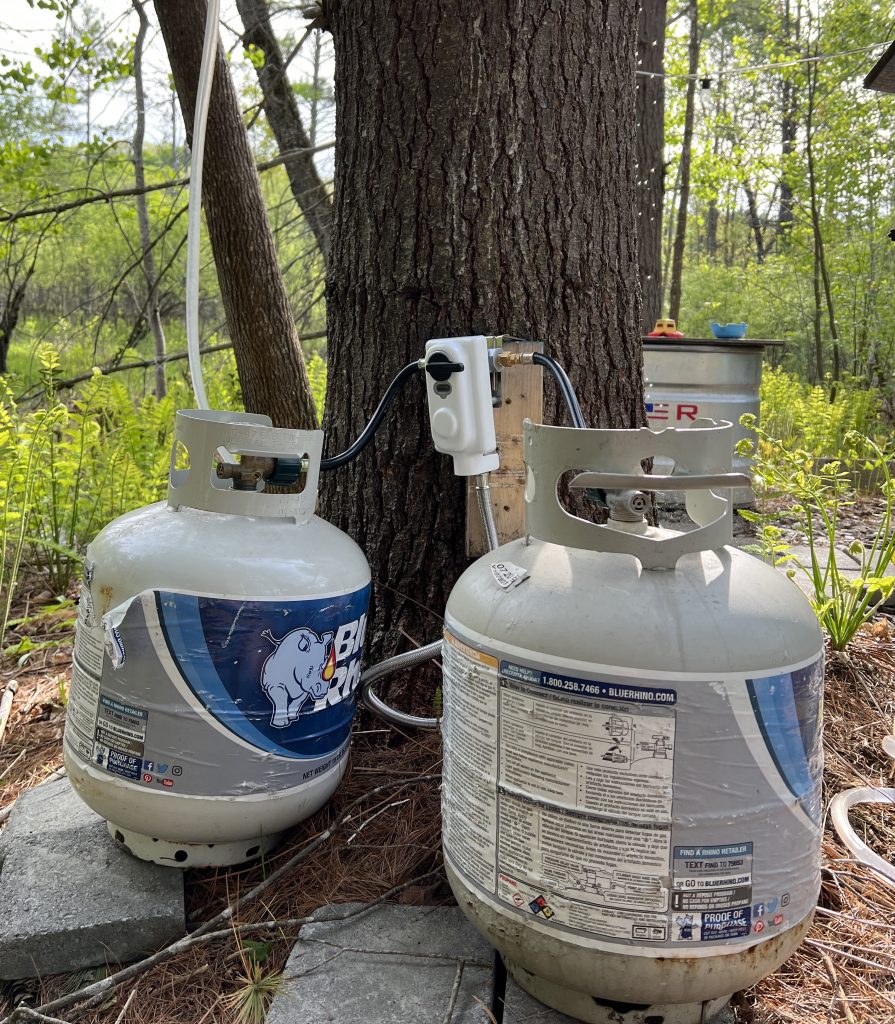
Continuous Propane Supply
It used to suck, when a tank became empty, to go get another one in the middle of a shower. This “auto change-over” contraption comes from the world of RVs and will alleviate that. I still need to make all this a little more stable.
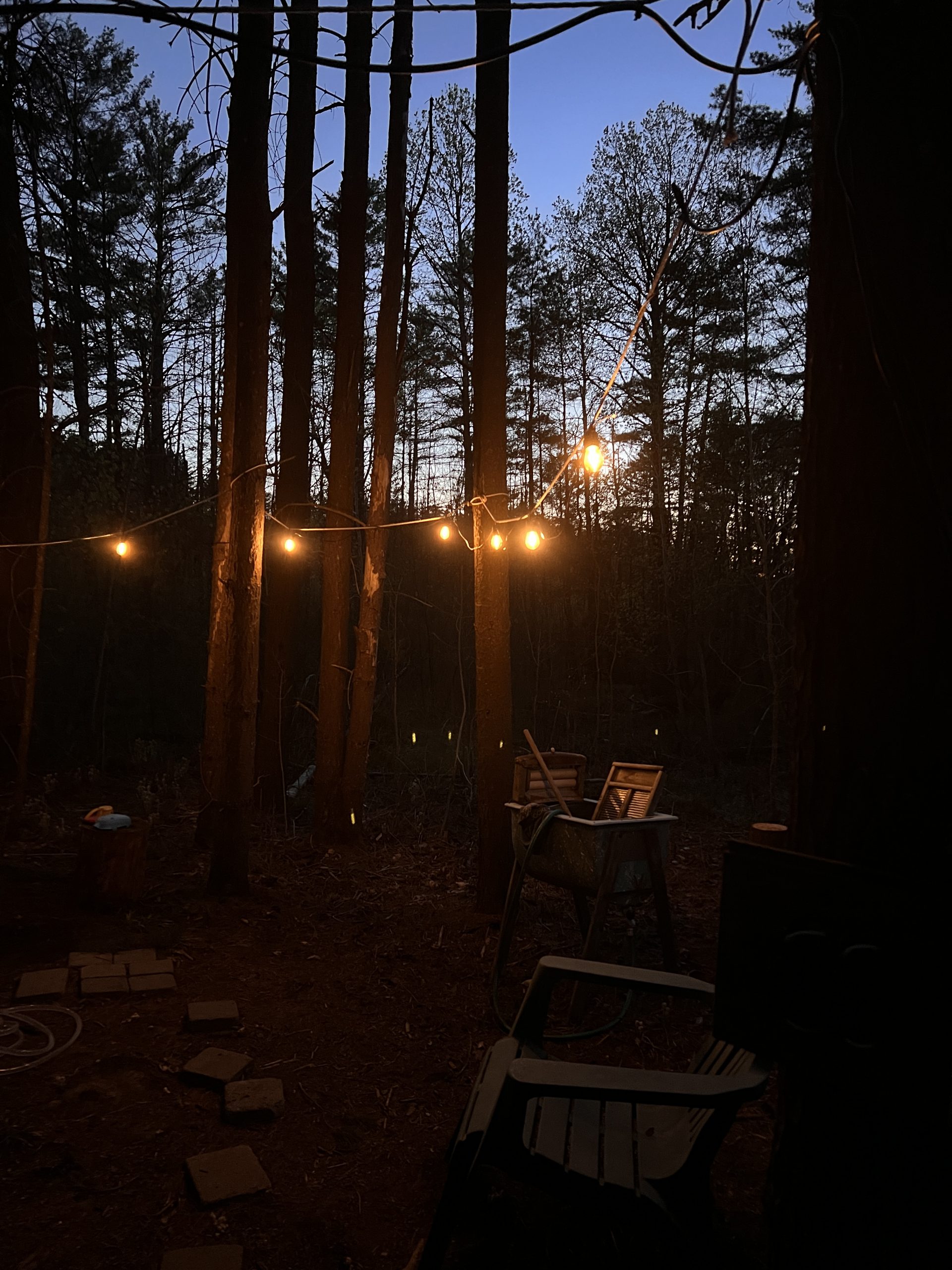
Lights
We’ll often be out there after dusk, and so instead of playing with flashlights I found some outside 12V DC string lights I could hook up to the little solar system we have out there to move water. It’s extra magical.
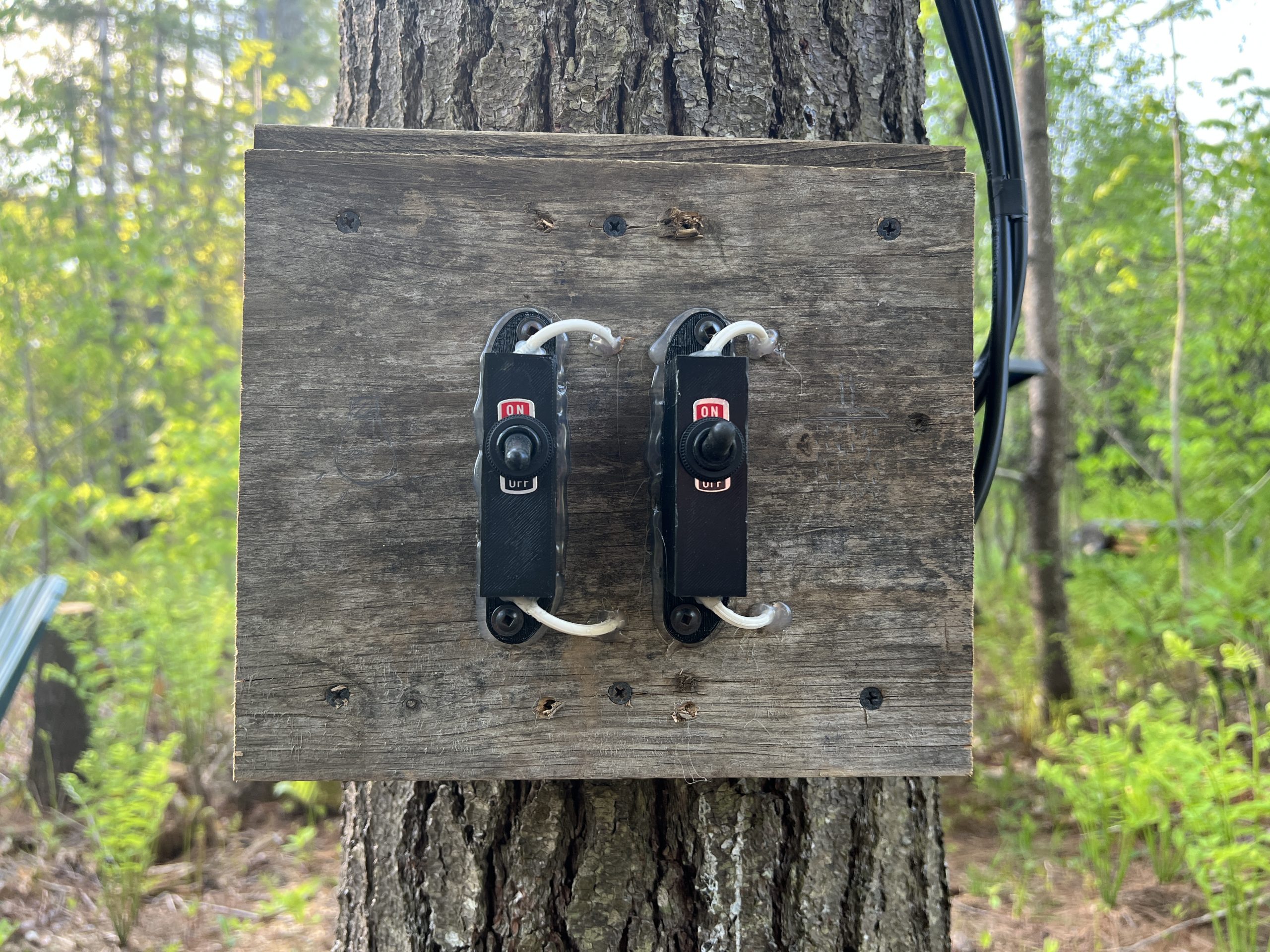
The very fancy control board
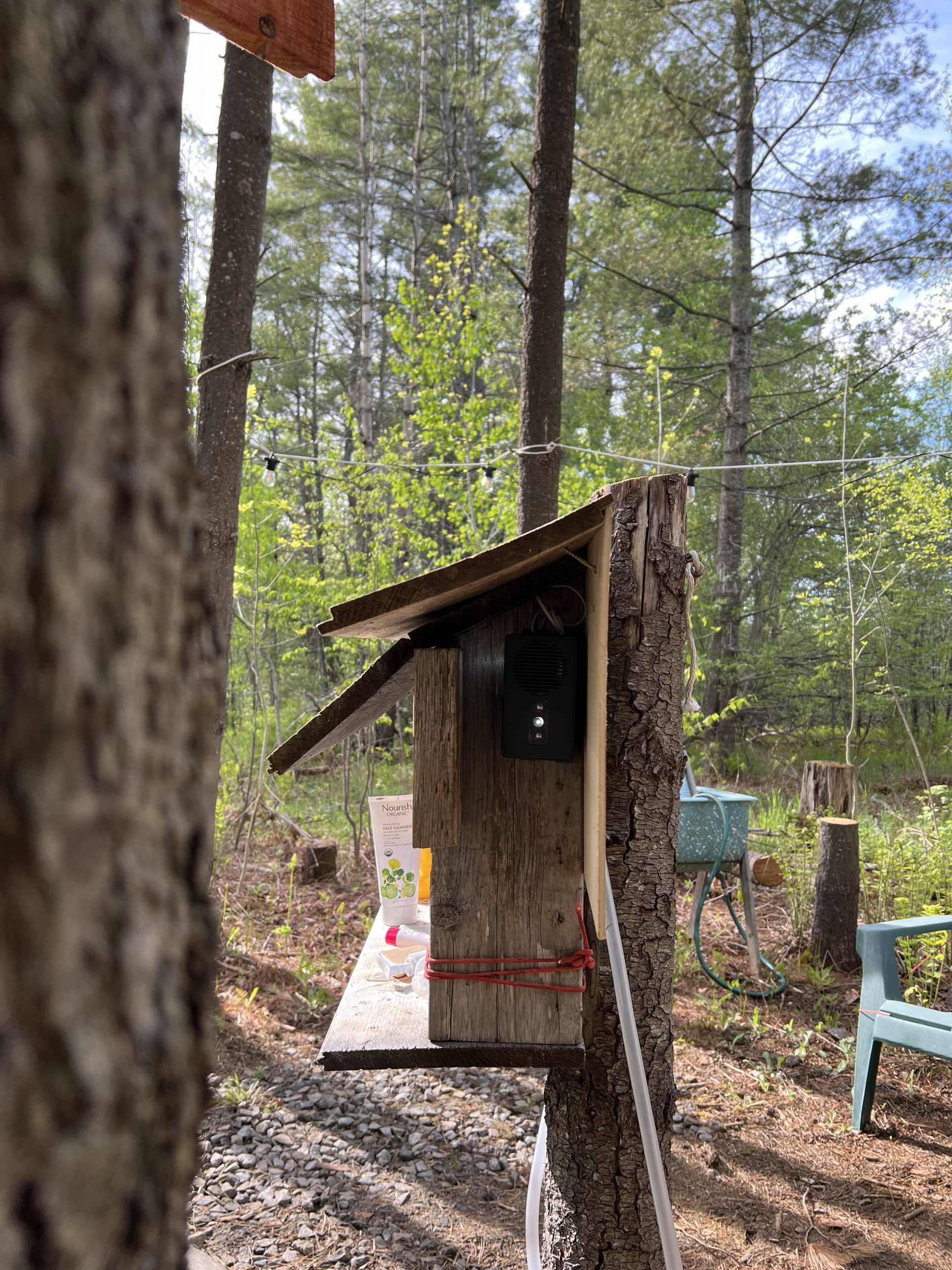
Pest repellant
last year a mouse built a nest right in the water heater one night. I imagine it must have been traumatic how its house turned into a sudden inferno. I had to disassemble it and clean it, no thanks. Also one day the water switch was just pulled to the “on” position, and we’re just not sure what happened but we blame squirrels. In any case, this thing there emits ever changing ultra sounds and LED blinking to hopefully keep all this away.
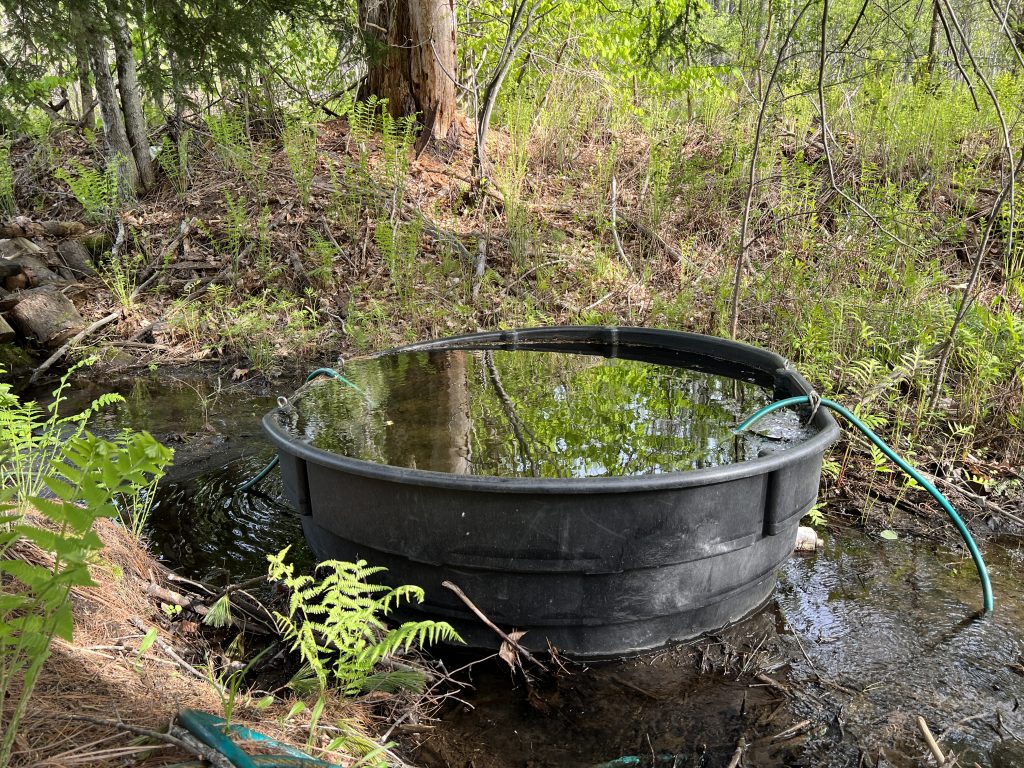
What’s the same
The siphon & sediment tub are the same, the formula works great. I did add an old battery to the solar setup, but it wasn’t really necessary, I just had it laying around.
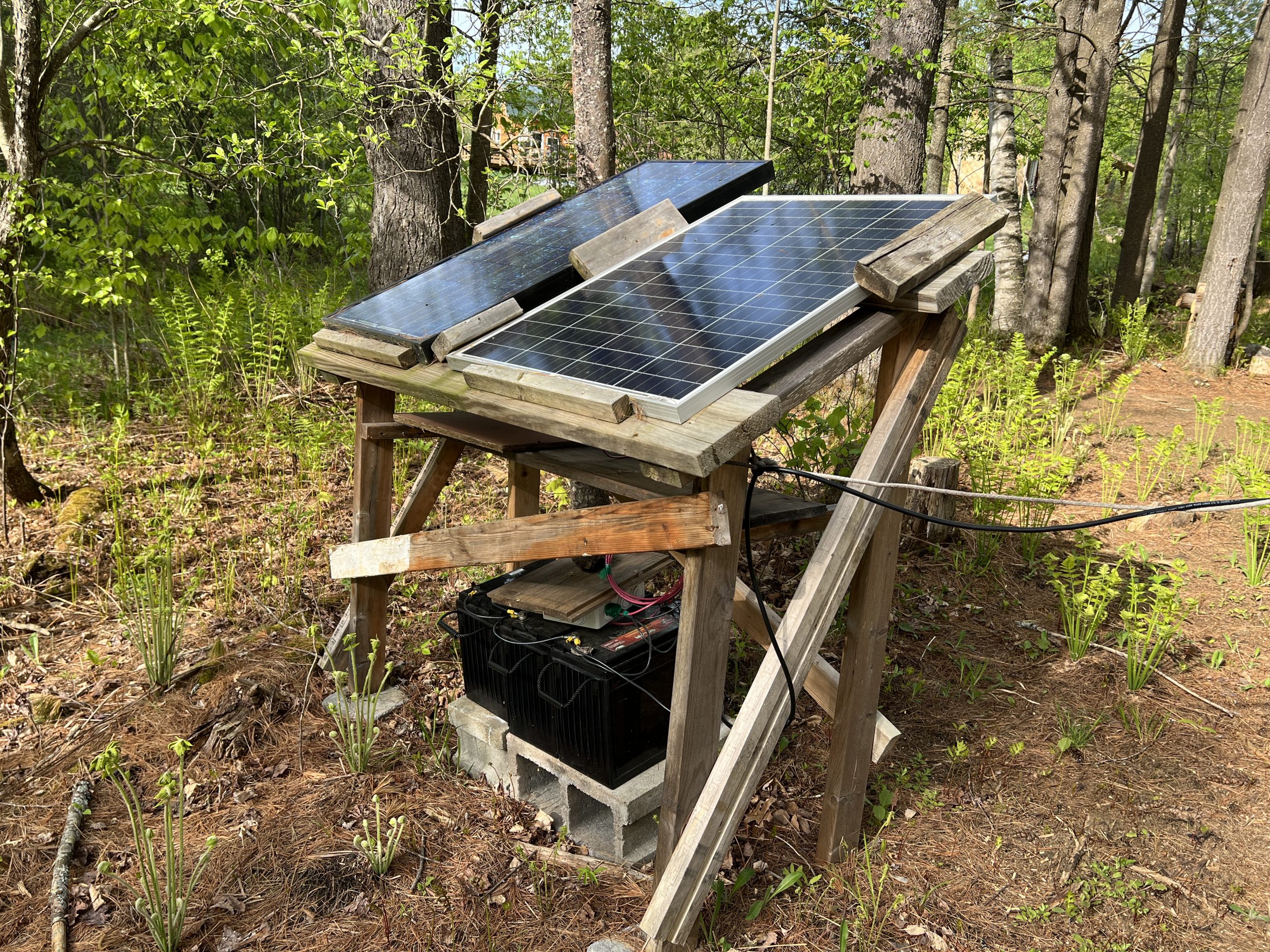
This very well may be the final incarnation of megadouche, it’s become a fixture we all love.
When your cat rubbing itself all over things impacts electrical production.


It’s fun but she doesn’t have enough surface to make a real impact :).
With our recent solar upgrade, we are able to produce much more than our charge controller can take. In fact, on days of perfect sun (full exposure, perfect angle) we need to turn off half of the array or the charge controller, which can only take up to 80A shuts off. This sounds silly, but on cloudy days, having all these panels is invaluable. So right now we’re a bit in a manual mode of turning panels on and off based on the weather.
3 years ago we had a brutal heat wave which sent us away from our house. I vowed then to have some sort of A/C capabilities before the next one. One of the nicest thing we’ve done to ourselves was getting a “regular” fridge. While at the time, it pushed our solar install to the limits, today it’s really not a big deal to keep going, even though it’s by far our biggest consumer of electrons. So we bought an 8000BTU A/C unit, I was expecting it to be maybe “a couple of fridges” worth of power consumption, but let me tell you… This thing is 7 fridges put together! Ouch!
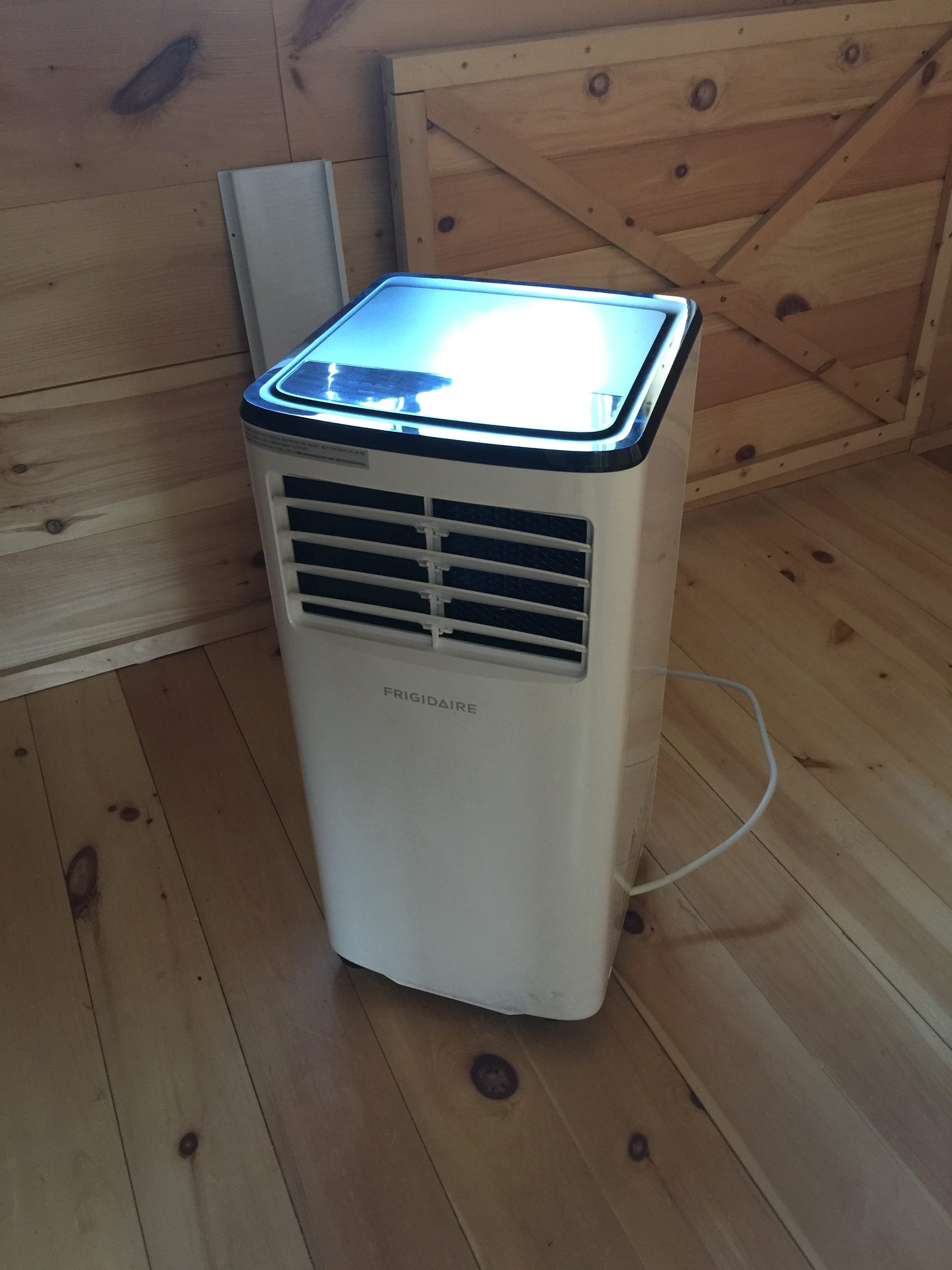
We’ve been testing it now to make sure we won’t have any bad surprises when the heat comes.

We’ll never have the battery bank to store and supply 70A through the night. Also true, when the Sun shines, the solar panels can most definitely keep 70A coming and more. We’ve gotten good with stove heat, at managing not heat itself, but how to buffer it in the house, to buy us time through a cold night. It looks like we’ll have to do exactly that, but with cold. Run the A/C all day while the Sun gives us more energy than we can do anything with, to buffer the house as much as possible against the heat. Nights usually provide respite from heat in the Summer, in the Winter this is also true but it’s the opposite of a respite when you are fighting the cold :).
So our panels are more than enough, our storage is essentially null for the purpose of A/C, and our charge controller is too close to its limit of 80A to funnel all the panel energy to the A/C while doing the few other things we need electricity for.
I think this tells us we need to upgrade the charge controller. This way we can have a more pleasant Summer, and more specifically mitigation of heat waves.
All for free, money wise and carbon wise. Amidst these mundane concerns of solar system design to tackle such a juggernaut device as an A/C, it is easy to forget how beautiful and elegant it is that the hotter the Sun is, the more we can turn it into Cold. How often are problems their own solutions?
We barely used our Champion generator these past 5 years, but it did come in handy on rare occasions. It sat for 2 years unused at one point and needed some TLC to get back going again, a fact we didn’t want another way. Working from home in the time of Covid, having upgraded our solar setup, and still not making enough power through very cloudy days, we had to compromise our values a bit more and get decent fossil based 🙁 regenerating capabilities.
I’m still gathering information on water and wind turbines to diversify down the road, but today we are not ready to pull that trigger and we need to work.
So we acquired a very nice Honda EU2200i, and a wonderful little device that plugs into it and produces 70A at 12VDC on demand.
The Honda generator is really nice and very quiet.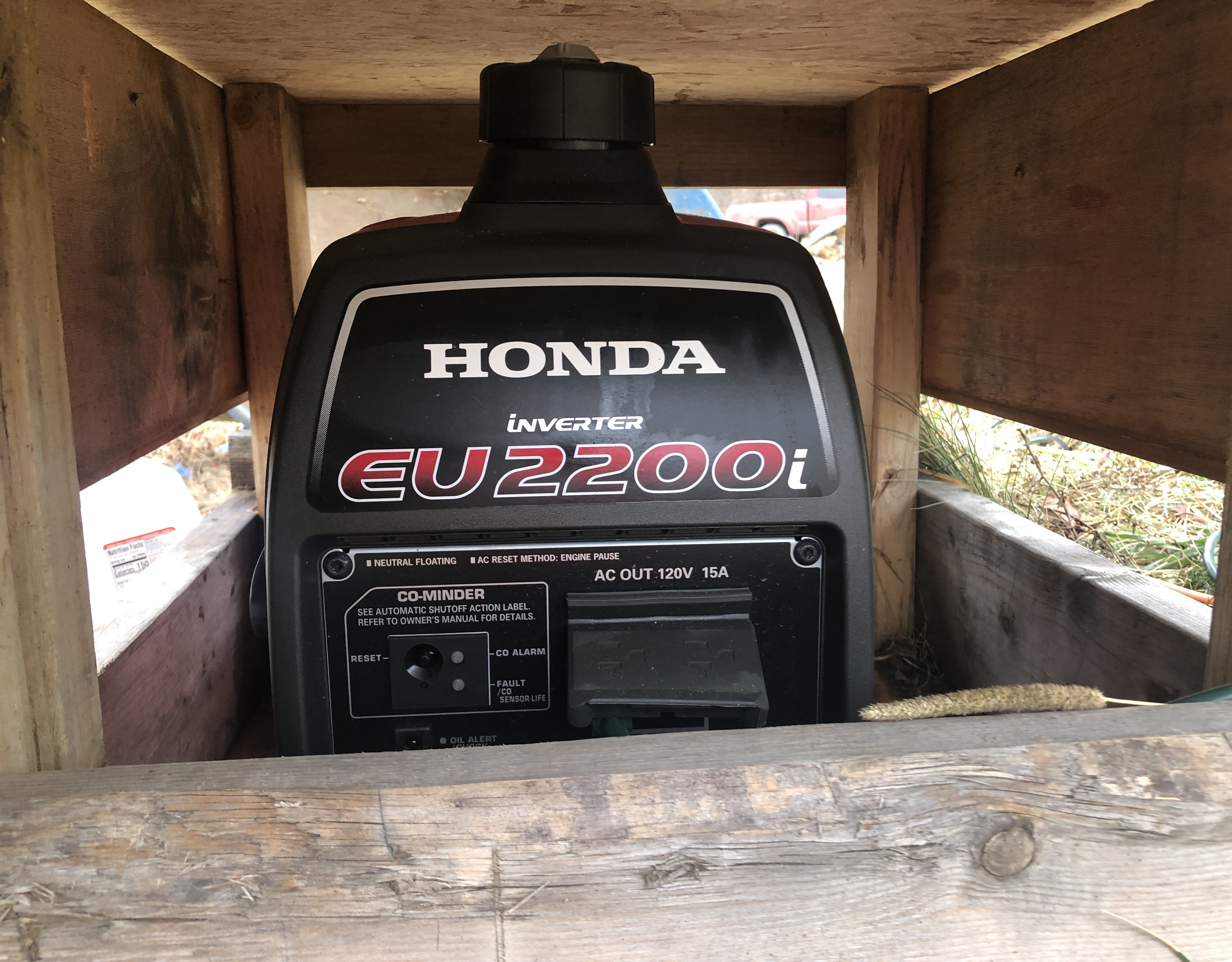
The AIMS Power CON120AC1224DC is very impressive, is can truly put out 70A on demand, it can be tuned to charge several battery types, and it decouples the load. I don’t need to switch the load to the generator, which means it’s always on the nice clean pure sine inverter.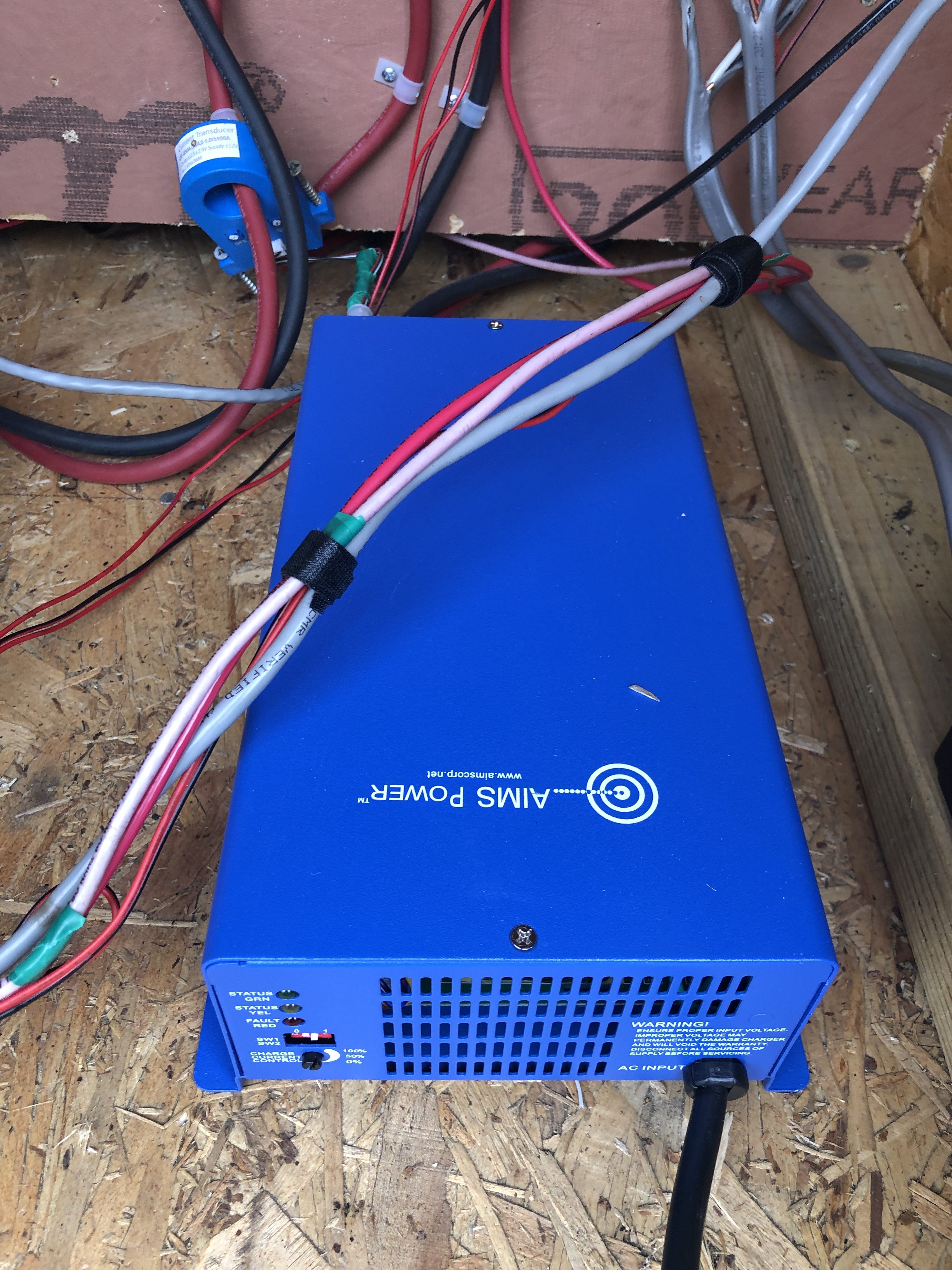
The Honda generator comes with Bluetooth, a fact I was not happy about as it’s gimmicky, but I have to say it is nice to not have to go back outside to turn off the generator. The AIMS converter is definitely working it hard.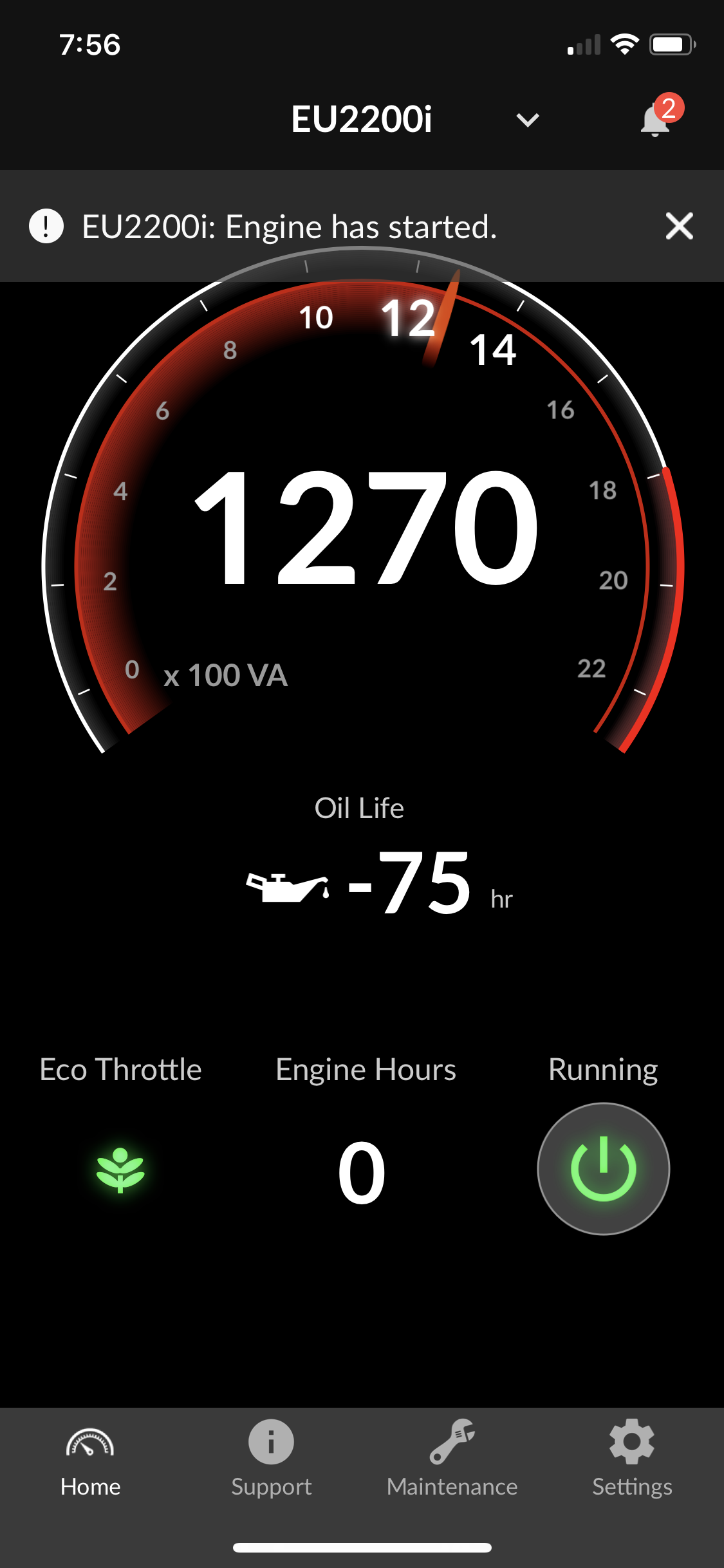
The results on the solar graph are, well, a bit absurd to look at :). 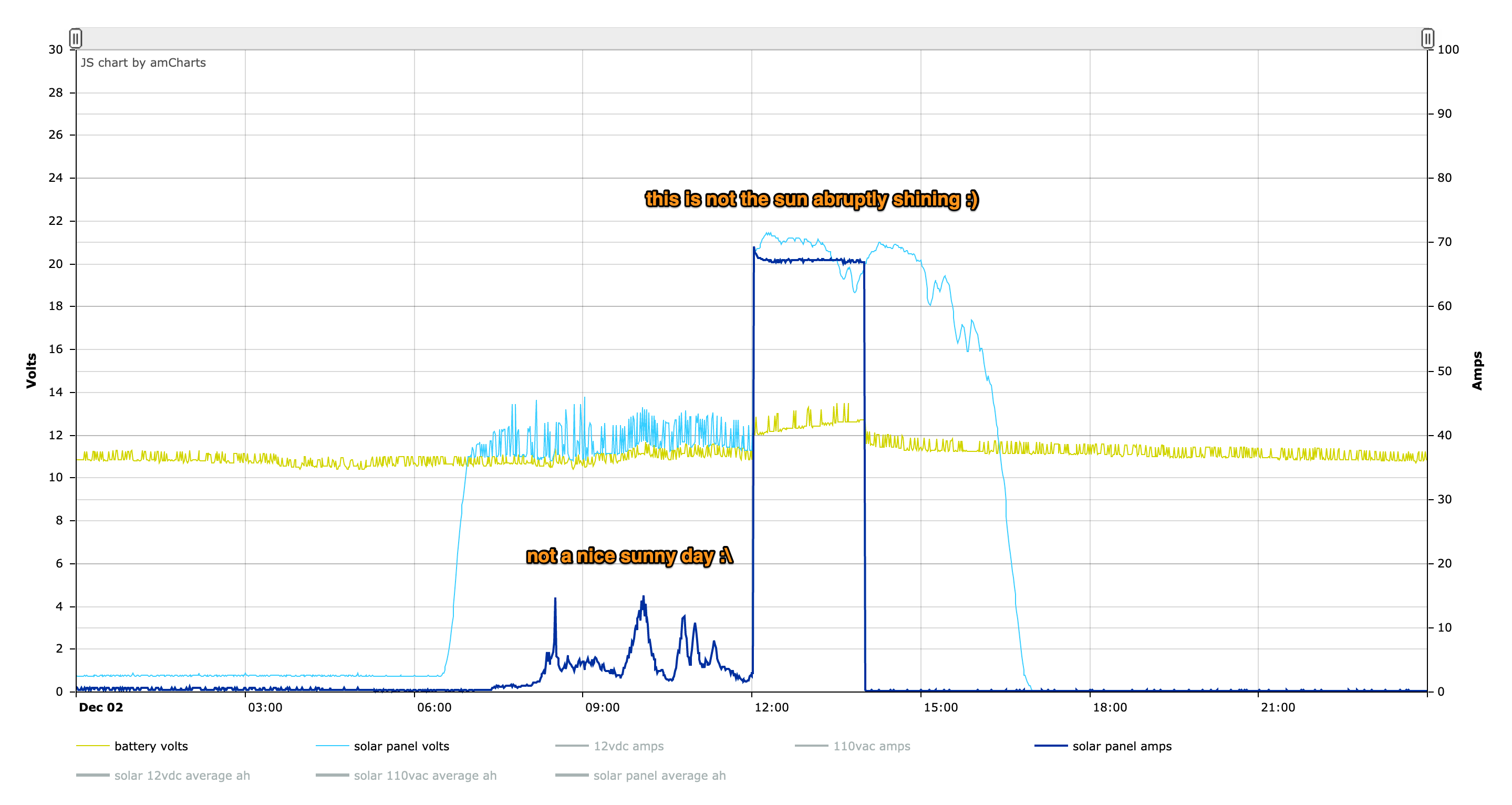
As Murphy’s law would have it, our solar upgrade coincided with a strange phenomenon which affected us for the whole month of November. Our batteries voltage took a sudden drop every night around 9:00PM going to well bellow any usable voltage and leaving us scrambling for power through the nights.
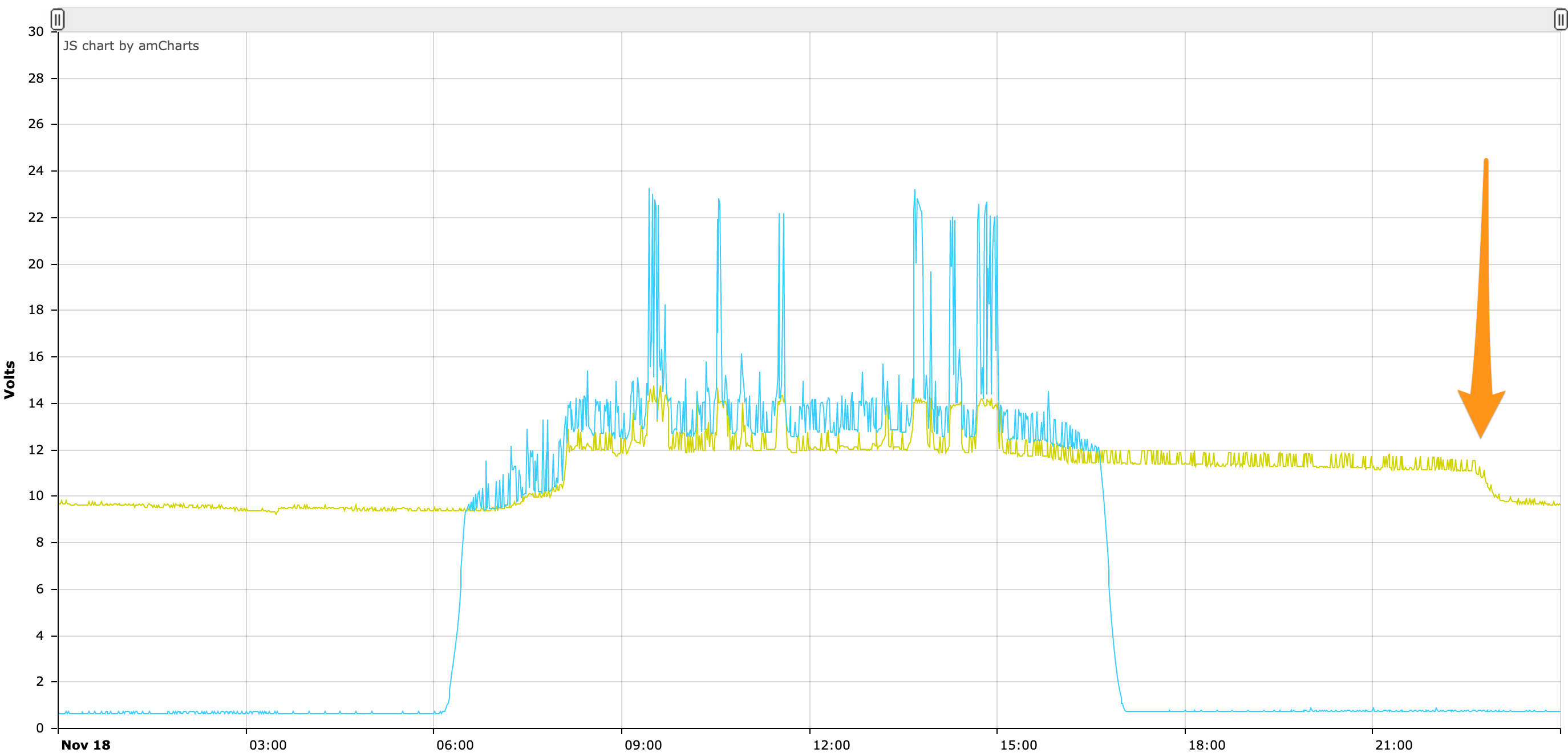
Because of this unfortunate timing, and my lack of understanding of all things battery related. I ended up chasing this dip for weeks, trying everything under the sun isolate it. Long story short, all our AGM batteries are shot.
Years ago I bought AGM batteries because they are more self contained and don’t require maintenance (no off gazing, no re-filling them). A choice that made sense when everything was new and too much to think about. Today, I’m realizing that the flip side of this is that AGM batteries have a shorter lifetime and that there is nothing you can do about it. Sure they were no maintenance for a few years, but today they are between 3 and 5 years old and we have to replace them all (all $1600 worth of them).
I reevaluated our battery situation, and with a much better grasp of all things solar, I decided to go with regular flooded lead acid batteries, they are deep cycle, they have 65Ah, they have a port to maintain the chemicals in them.
It does mean I’ll be poking at them every couple of months to better quantify their state and not let a slow boiling voltage dip sneak up on me. And I’ll be maintaining the chemicals (mostly adding distilled water on occasion).
This conclusion was confirmed by chatting with a couple of old timers who have been off-grid for decades. One gets 6 to 8 years out of his batteries which are allowed to freeze (our situation today), the other gets 10 to 13 in a controlled environment and a water turbine providing constant power 24h a day. This helps the batteries not cycle so much.
It was a real education talking to people who have been doing this for decades. As I build my own experience, I make mistakes and sub-optimal decisions. For today though, I’ve eliminated a blind spot of our solar setup. I can recognize the phenomenon for what it is, the data I collect was really helpful and I have ideas for algorithms to interpret them automatically and get a health measure of the battery array.
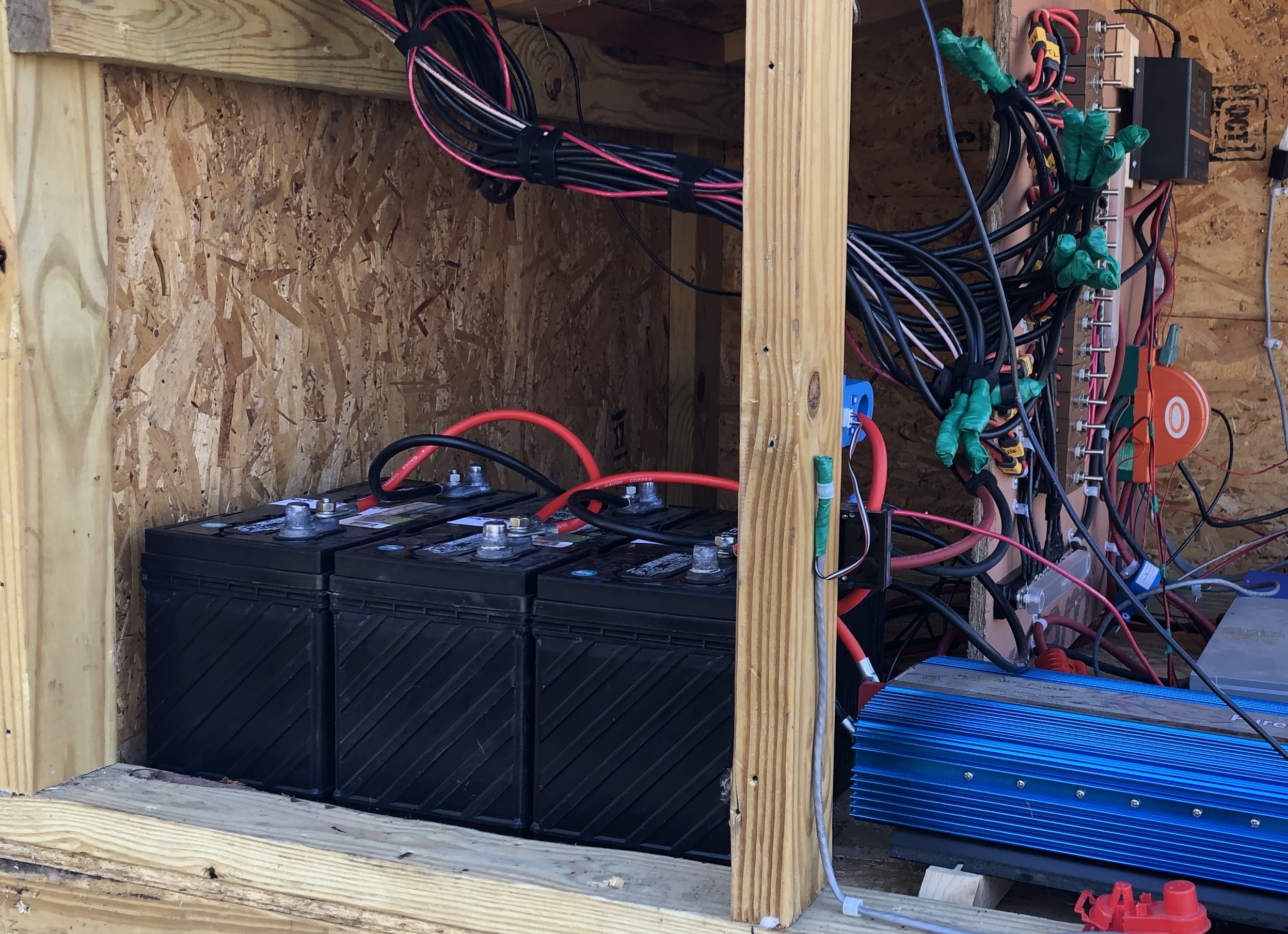
So I bought only 3 new batteries, giving us 195Ah to get through night and cloud. It turns out it’s a thousand times better than where we were with our theoretical 775Ah as it had slow boiled down to pretty much nothing :). I’ll get in the habit of maintaining these batteries properly.
November 9th 2019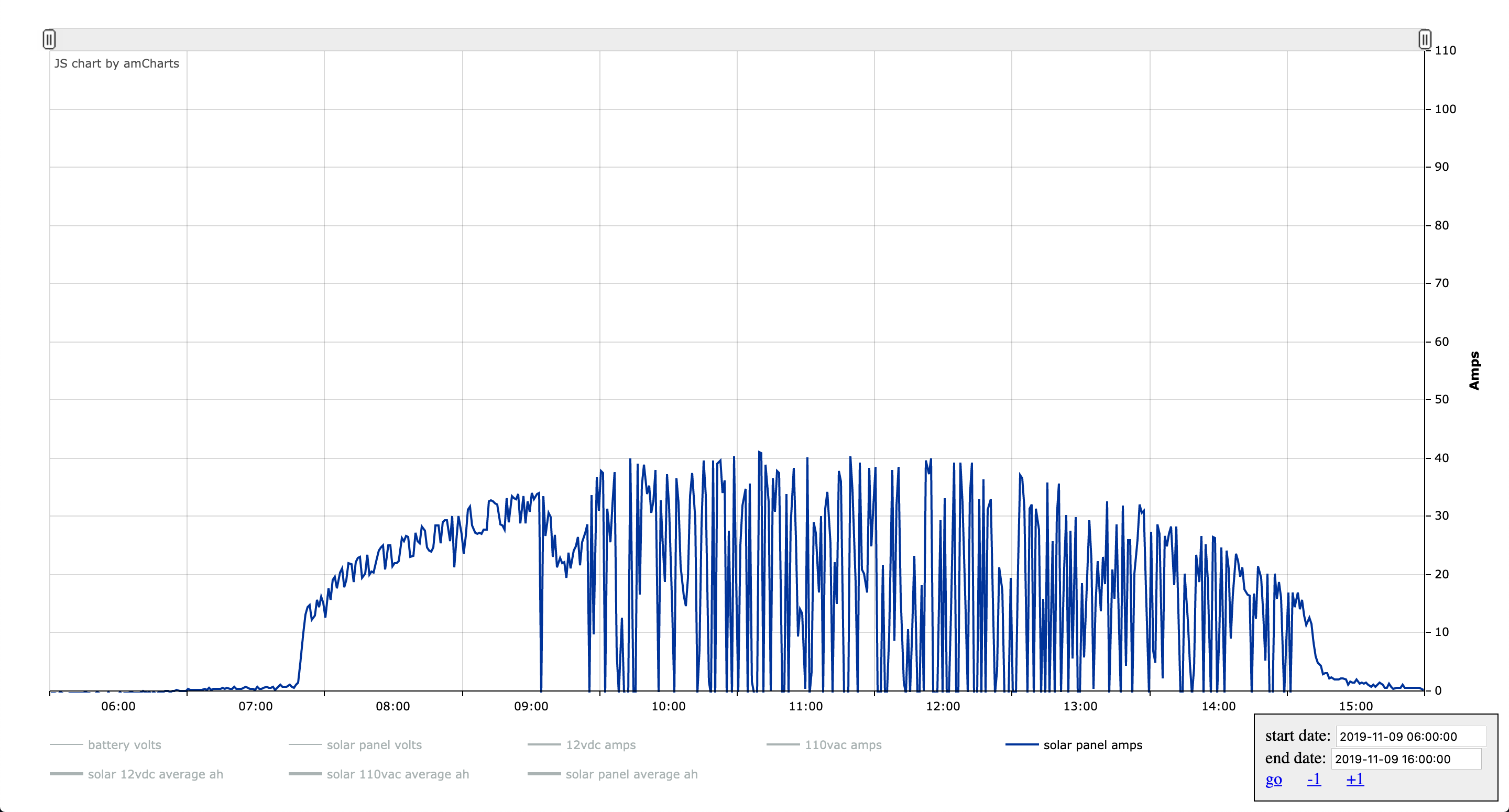
November 9th 2020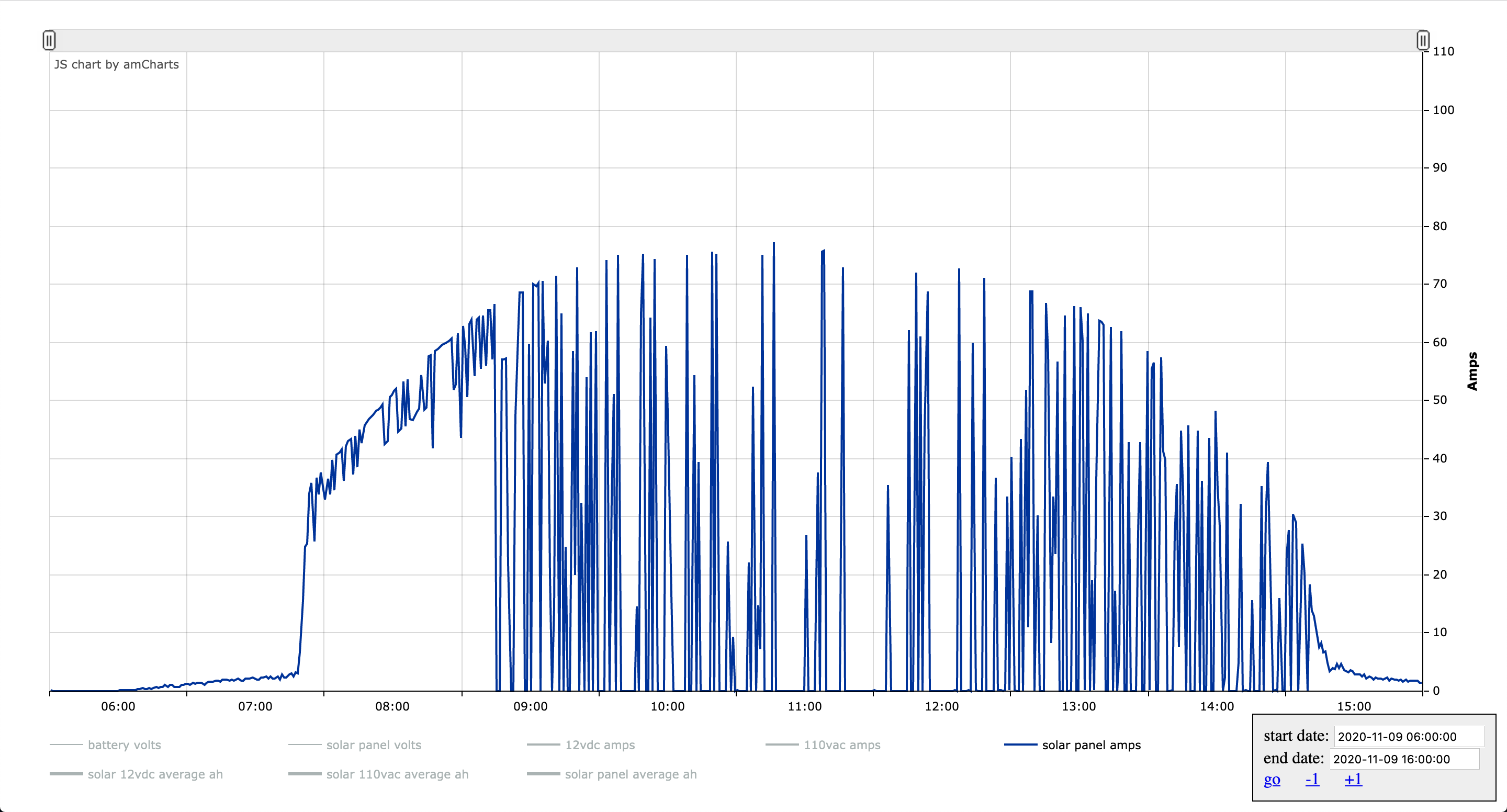
And just for fun, here is November 9th 2015
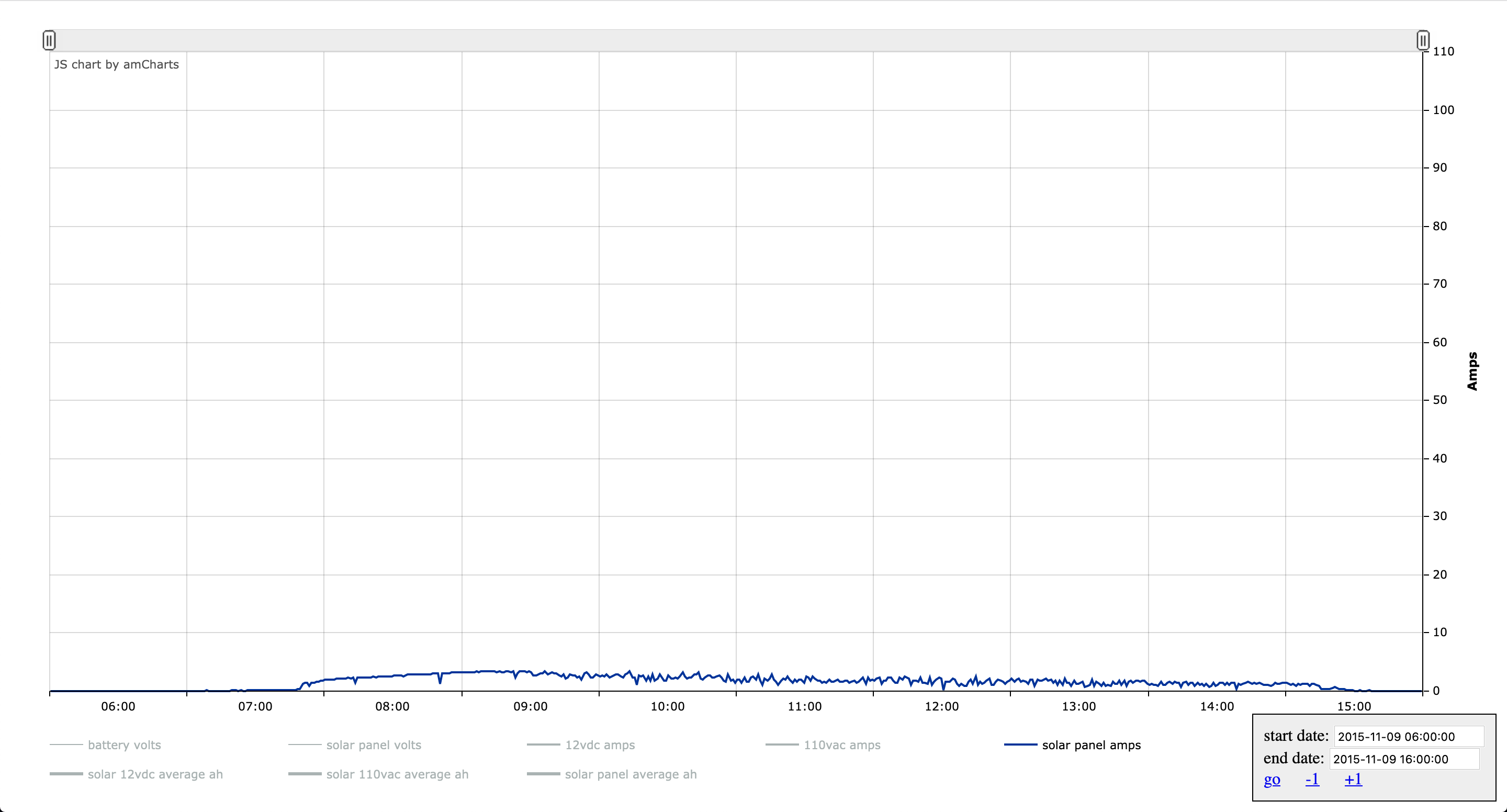
We’ve come a long way 🙂 It’s supposed to be cloudy tomorrow. This will be a good test of the strategy that is trying to squeeze more amps with more panels from a non-optimal day.
Our demand for electricity surpasses our ability to produce it often these days. Between the fridge, working from home, kids growing up, and soon a water pump, we’ve expanded drastically but our solar setup has not. With Winter looming, it was time for an upgrade.
We can pick 2 strategies for an upgrade:
The former doesn’t make sense for us right now, battery lifetimes wouldn’t be in sync, and they freeze on the really cold days which is not advisable for their long term performance. Batteries are very expensive and we know that whatever we get will take a beating. In a few years, when we have a root cellar, we’ll also have an ideal place for batteries which won’t be subject to drastic temperature swings, then it will make sense to upgrade those. In the meantime, the only strategy left to to milk the cloudy days for more by buying more panels.
I couldn’t find the exact same panels so I bought some similar, and well, I had to get 9 for things to look symmetrical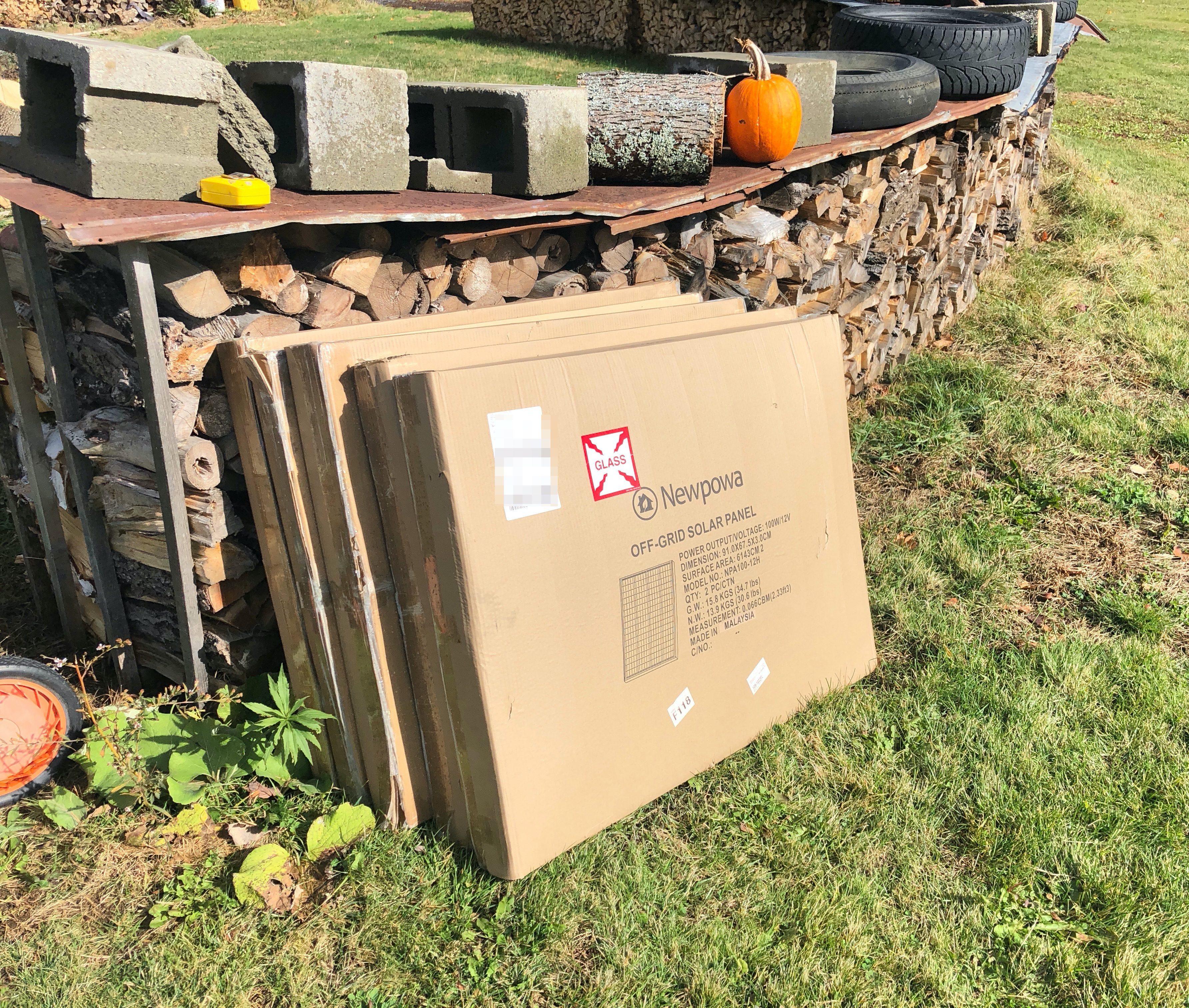
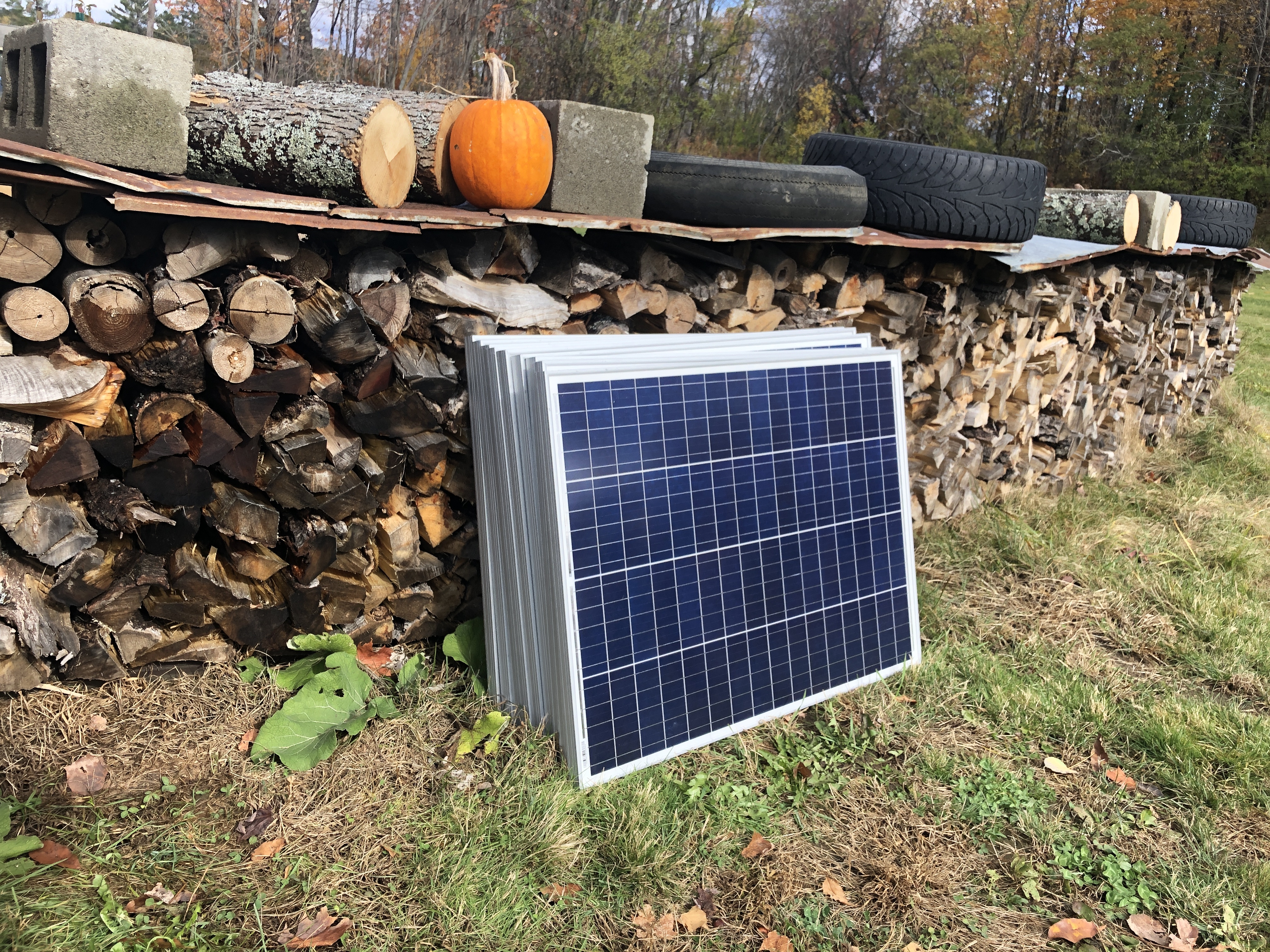
I went vertical because I like where everything is now, I didn’t want to increase the panels’ footprint on the land.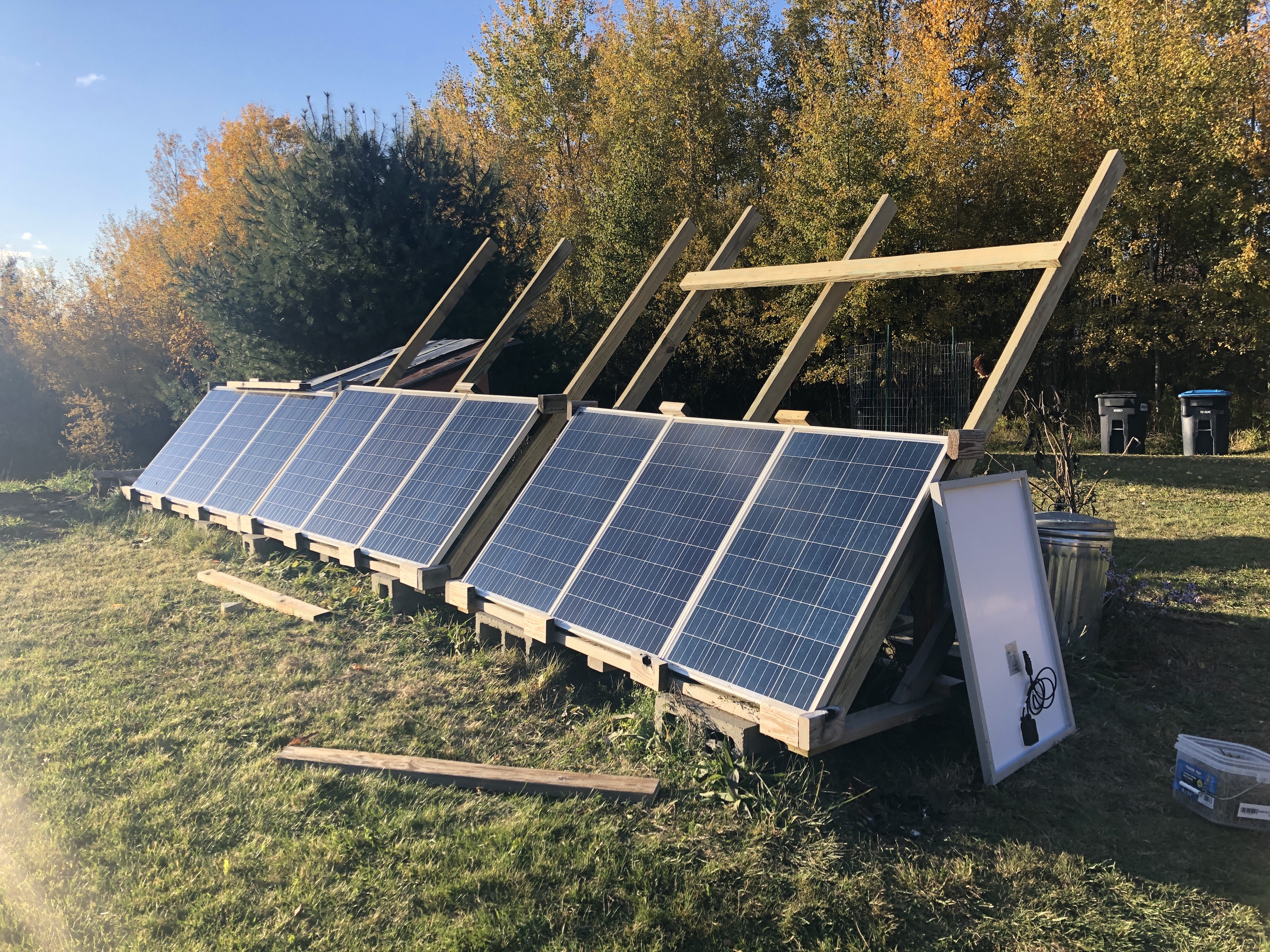
I expanded on the existing frames made of pressure treated 2x4s. It looks a little eclectic and that’s ok, it works well :). We do get very high winds here so I have to build sturdy or I’ll be picking panels off the ground after a storm.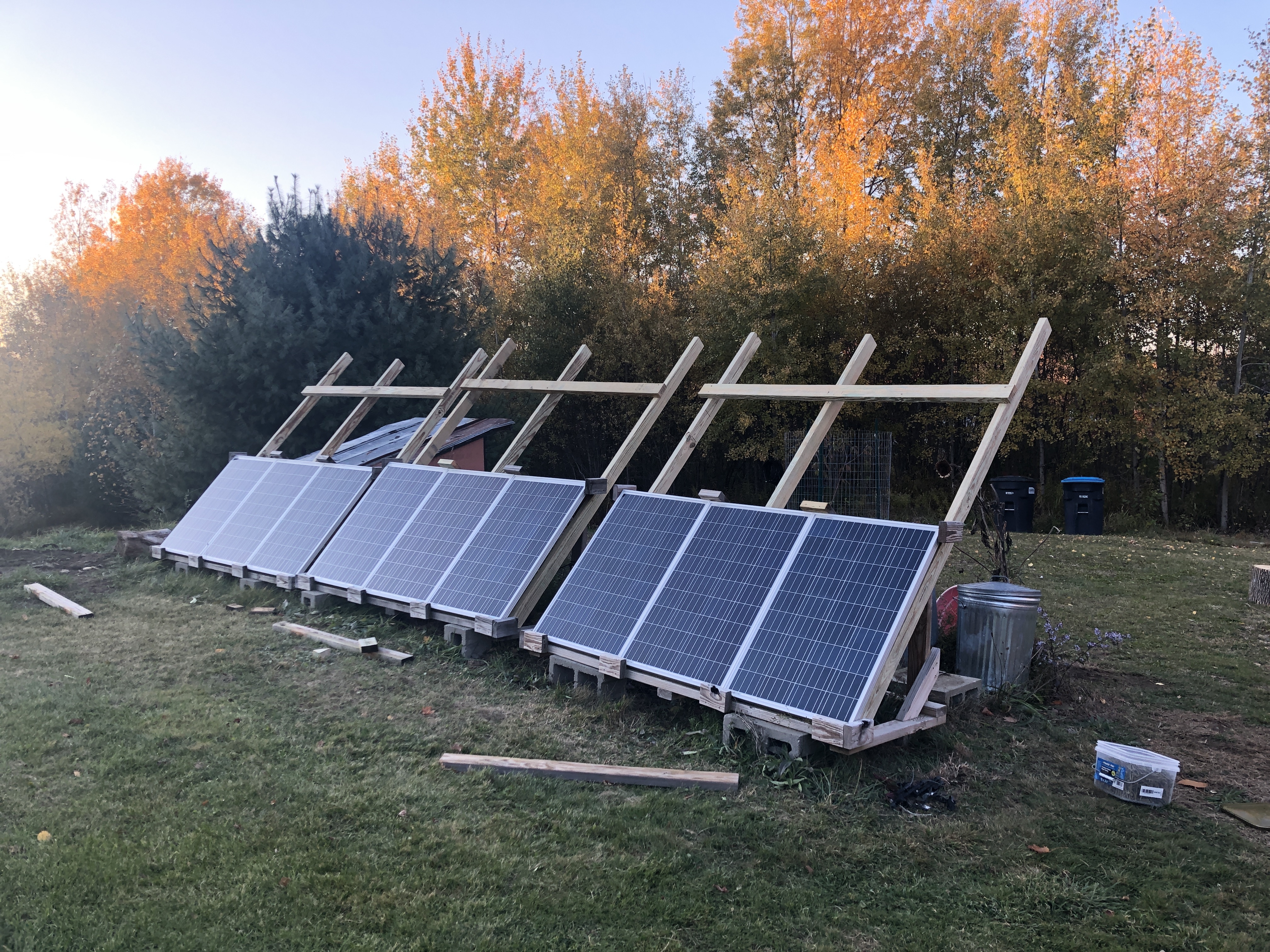
Now this is starting to be a serious array. I don’t think we’ll ever need more panels than this. Note that the top row looks a little different, as I said they aren’t the exact same panels.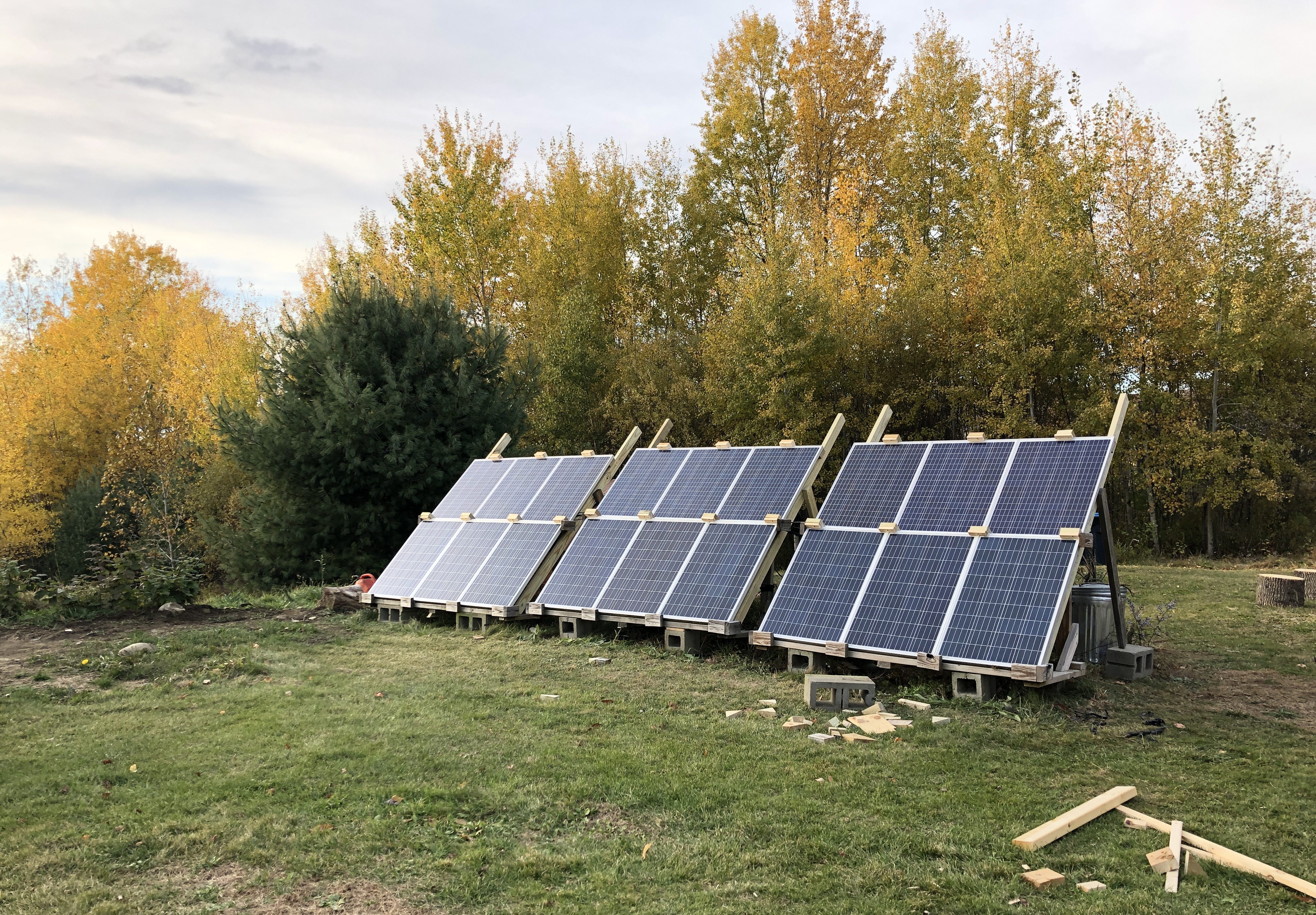
Because we have more panels, everything downstream also needed to be upgraded. Truth be told, it needed to be upgraded a while back. I was definitely pushing the gauge of the wiring, and a lot of things I had done poorly as I was learning. I rewired everything with better gear, better knowledge, and dare I say better skills.
I started work on the control panel of my dreams inside. I’ve gotten to appreciate just how much time, and how much skill proper wiring takes.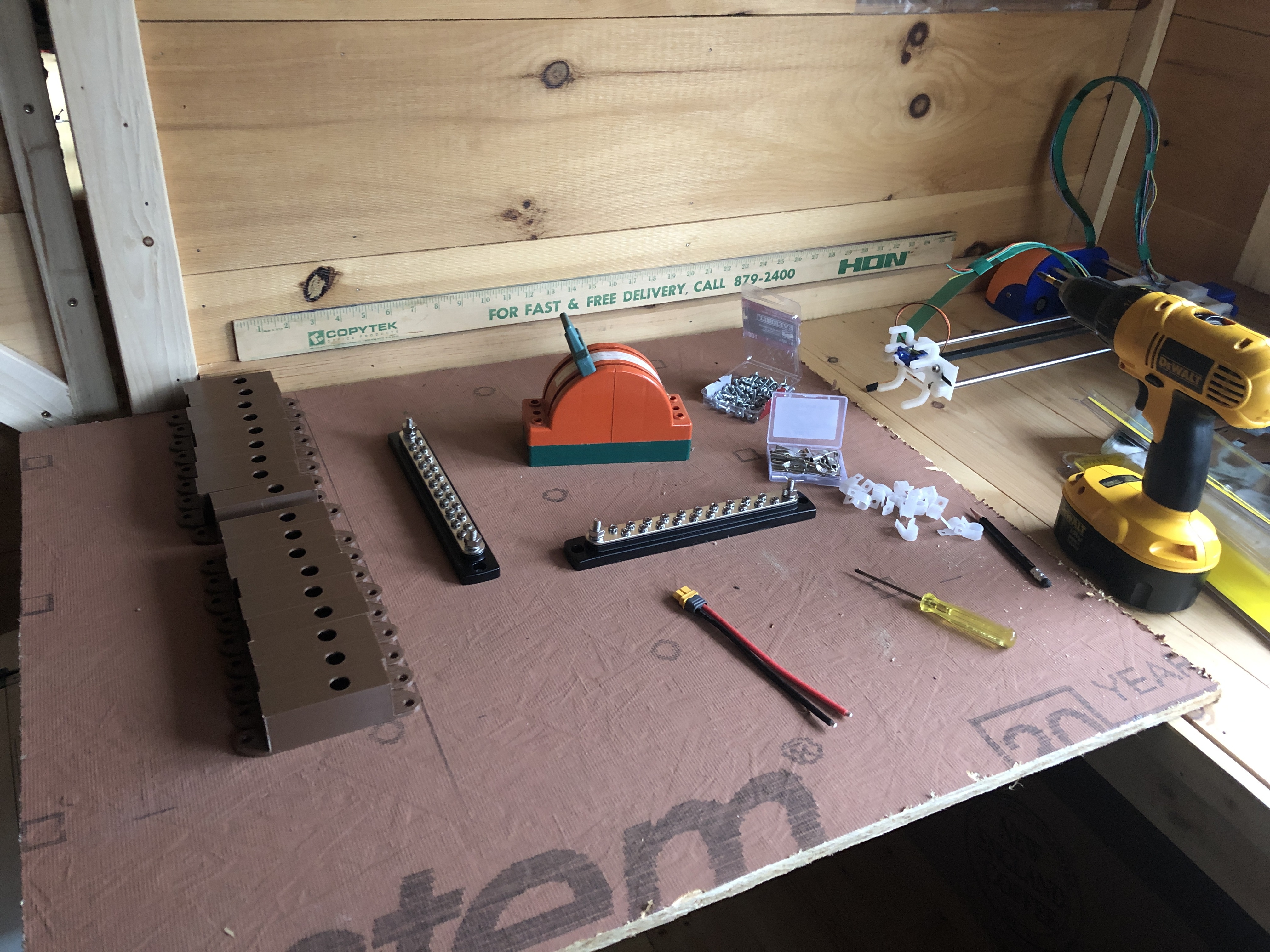
Each solar panel now gets its own wiring, with an on/off switch and a diode to prevent electricity feedback. The panels have their own diode locally to prevent feedback damage, but between they and the control panel, there’s a lot of wire one could make mistakes with. Working together, they can produce 100 Amps and so you really don’t want feedback. I soldered heavily (and uglily) any connection I could.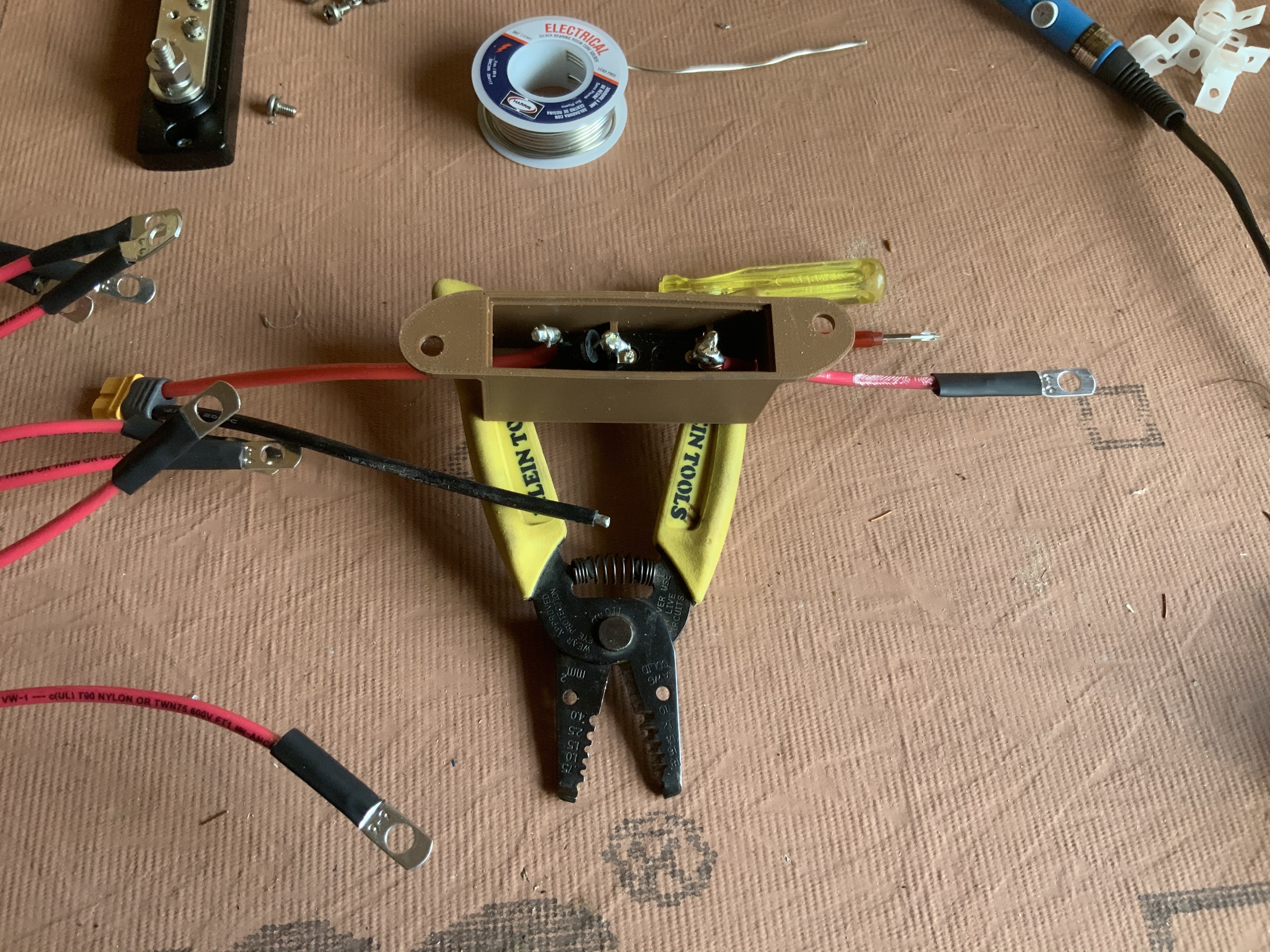
The solar on/off button casing is an fork from the previous on/off switch casing but with room for a diode and made so they can stack.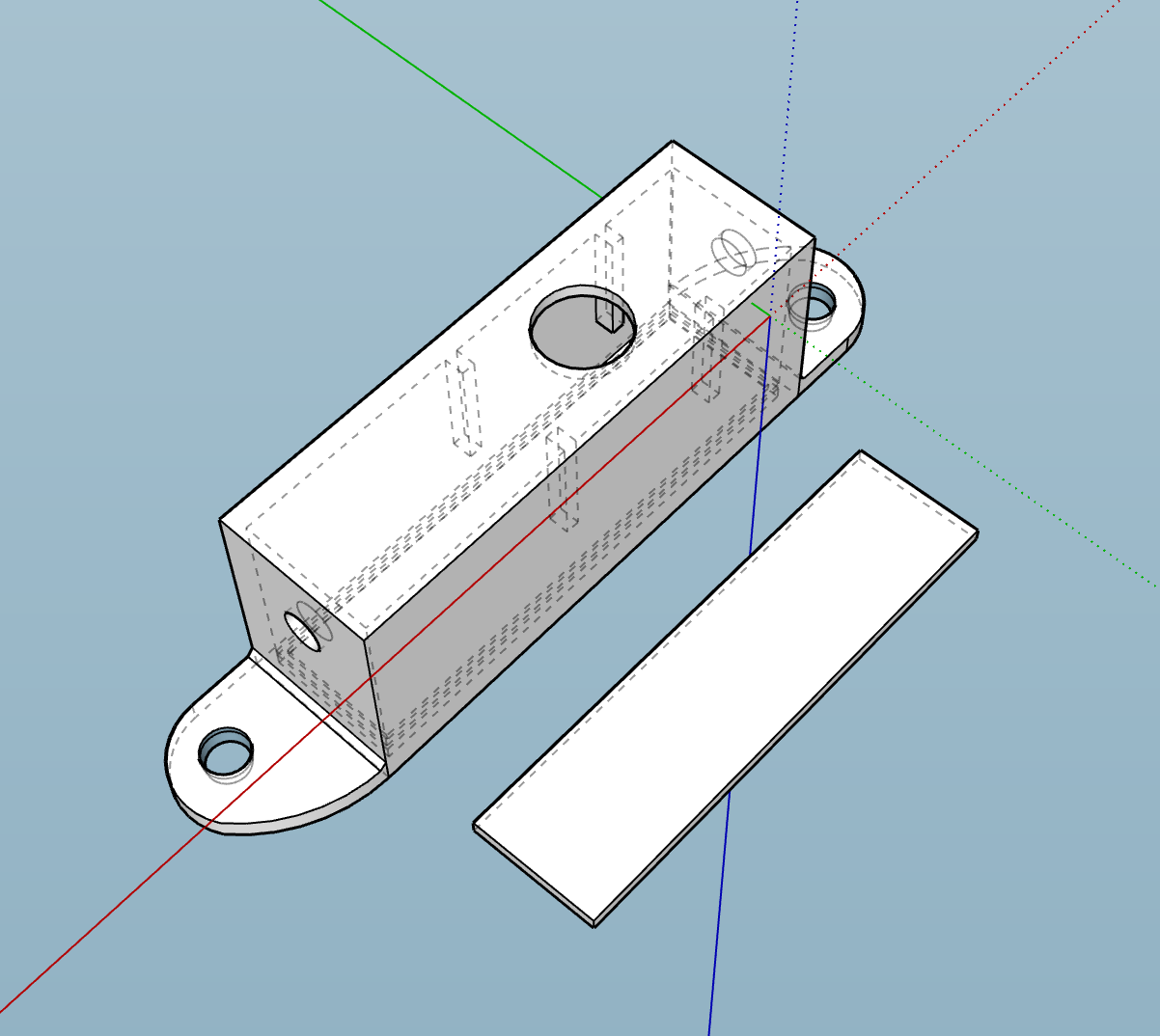
Download links here:
solar_on_off_button_casing.stl
solar_on_off_button_casing.dae
solar_on_off_button_casing.skp
I’m also making the control panel fully detachable, anything connected to it has a plug. It’ll make it easier to work on down the road.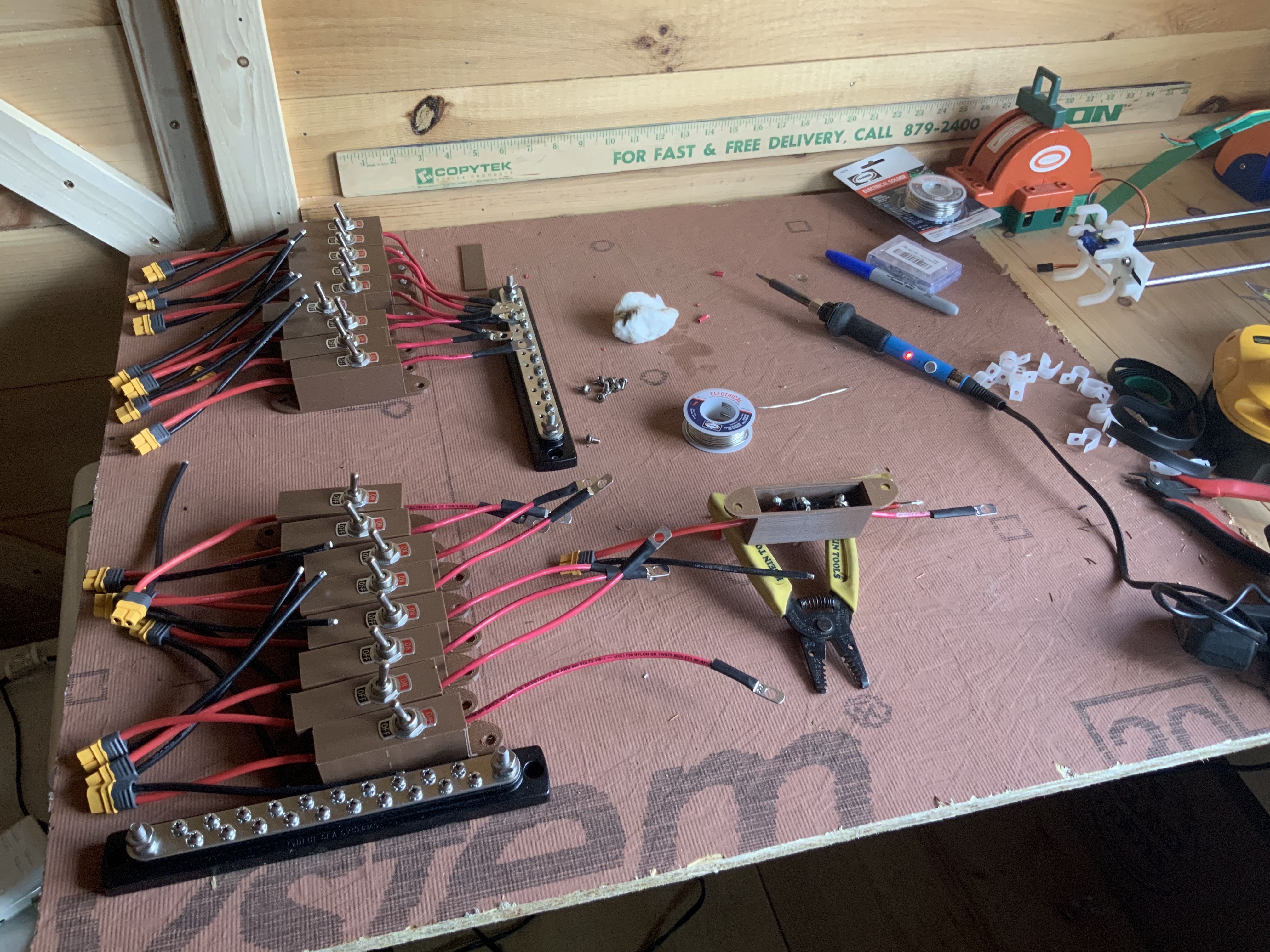
Now we’re talking!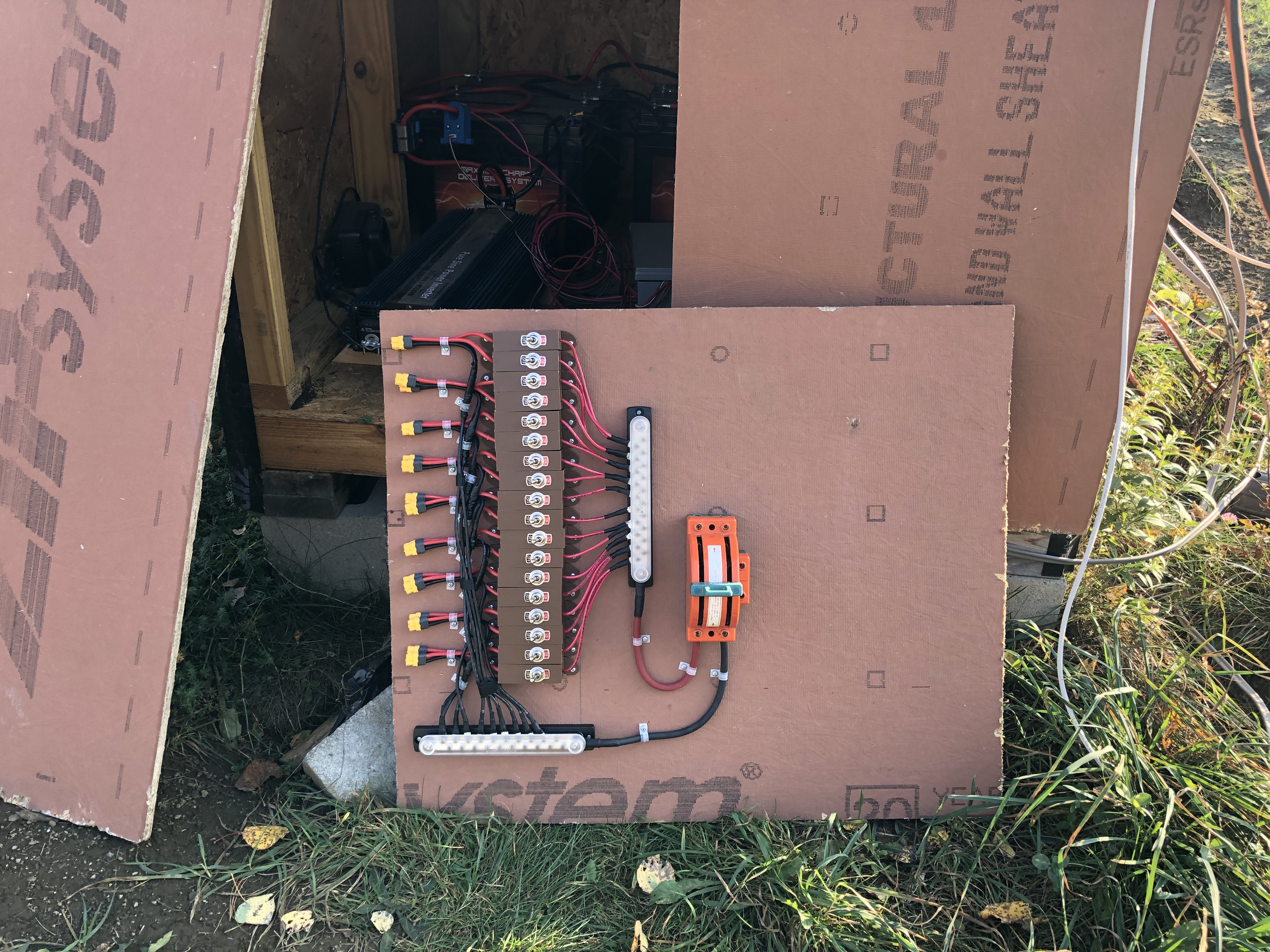
Long story short, it took several days of work to rewire all 18 solar panels and create this awesome control panel. There are still a few things I need to polish or position better. I “reverse-engineered” what powers our fiber ONT so I wouldn’t have to rely on an inverter to power a UPS to power it (ouch for efficiency). Turns out it just needs 12V, guess what I have plenty of in this solar shed? I got a 12V power cleaner (the aluminum radiator looking square to the right) to at least give it a very clean 12V, the other pins are optional signal pins to take various UPS actions based on power scenarios. It really didn’t make sense to jump through all these hoops to have a 12V battery backup when my whole system is essentially a 12V battery backup. We’ll see if anyone comes knocking on my door :).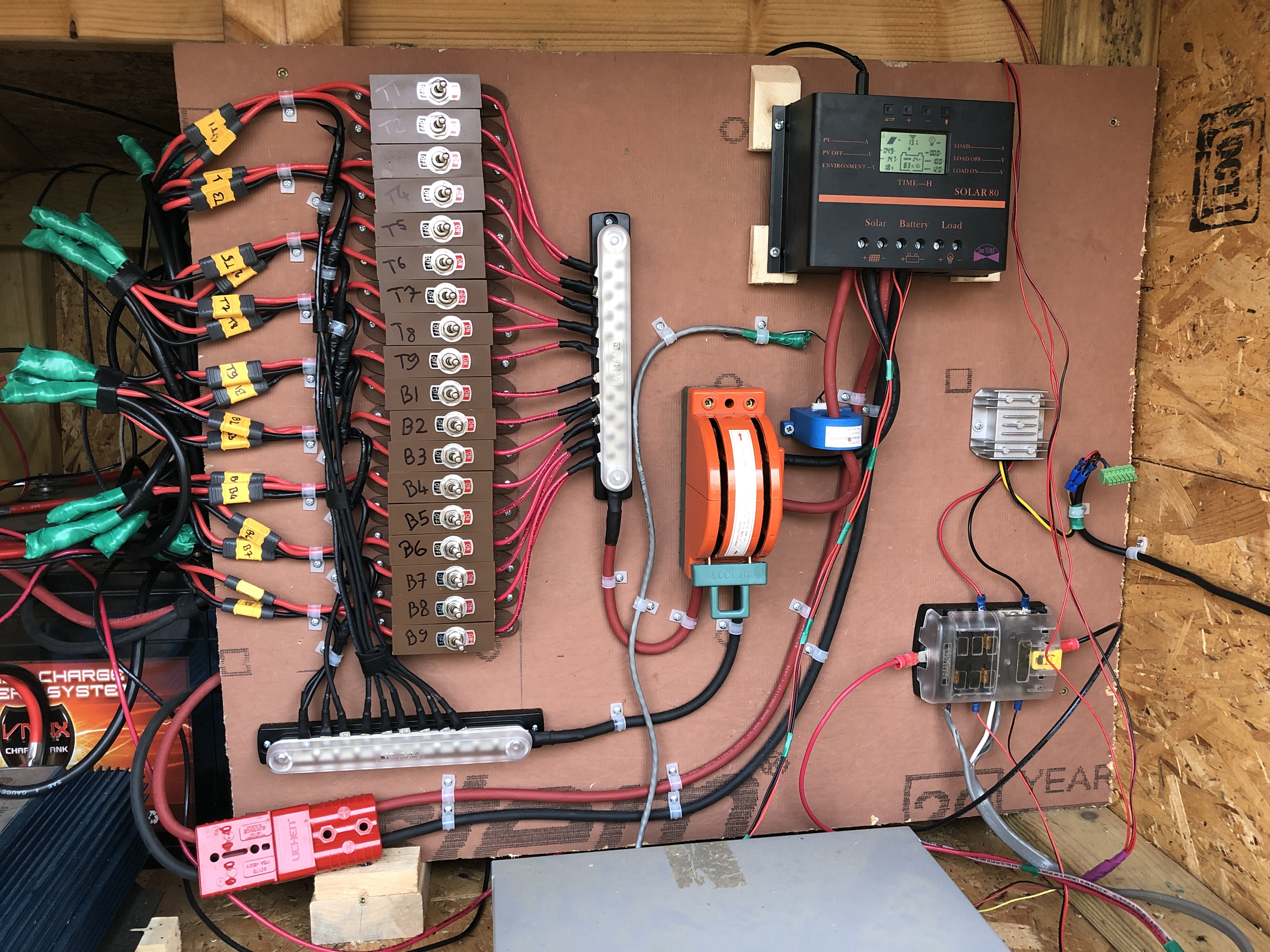
The smarts for monitoring and hosting this very blog are mostly untouched but I did re-arrange them a bit. I tried to fit everything on the control panel but it made sense to separate by function.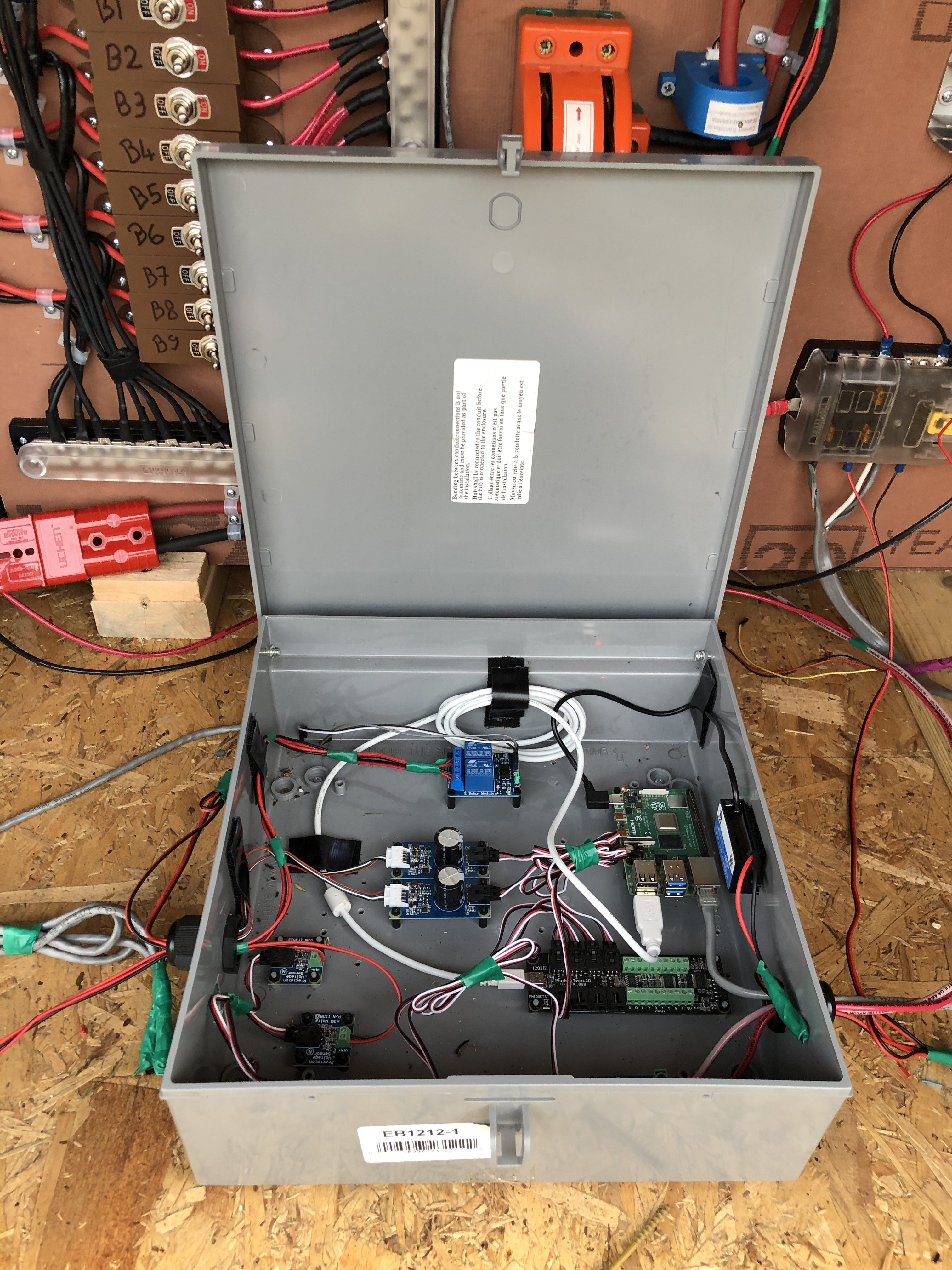
Robin enjoyed playing with the switches, including the big catchunking one. We experimented with various scenarios, compared panel outputs et cetera. This was a nice unforeseen side effect this design.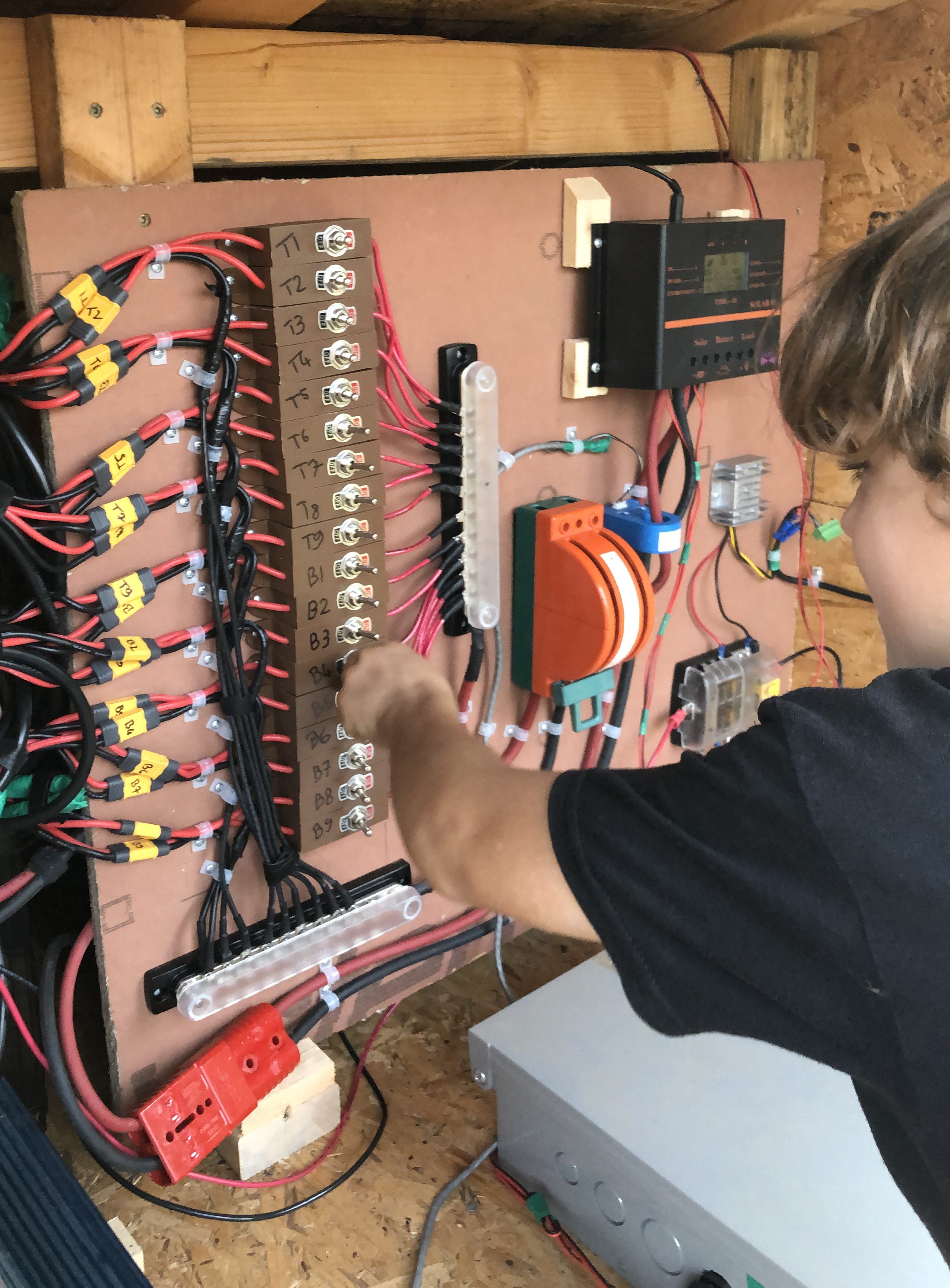
All in all I still have a bit of work, but I knew exactly what I was doing and didn’t make a single wiring mistake which is really nice. I used to be way more puzzled by how to wire something much more basic than this. The charge controller stopped working mid-day, that’s because it stops at 80 Amps and the panels had reached this. Fortunately, it was very easy to turn off 4 panels and the system worked again. It’ll be just as easy to re-add them on a cloudy day. The real solution will be to upgrade the charge controller, this will be left for another time. With the Sun almost gone well behind the tree line, we were still making 2Amps, this is now definitely a nice setup :). “Legit Brah” as Robin would say.
That’s it, after 4 years of slowly learning and ramping up our solar production, we figured out enough to run a fridge. In truth we’ve had capacity for a while now, but I had things wired sub-optimally in a way that prevented us from running anything requiring surge power (power tools, condensers). Silly me for wiring our load to the “load” port on the charge controller, this port is apparently only intended for small loads. It always blows my mind how incredibly disparate information is about solar installs online. There’s so much fuzziness, various understandings, theories, concepts which apply, or not, no one really knows. Most posts are a person asking some random simple question followed by 50 answers going deep in the weeds on some highly specific aspect, unrelated to the question, and that no one but its writer gives a crap about. In one of these random threads someone alluded to this fact, that the load port on the charge controller isn’t really meant for anything surging. Sure enough, after wiring the inverter straight to the batteries, I can power fridges, ACs and power tools. It’s a very nice step up.
Now of course because nothing is ever simple I had other issues with our inverter so I just got another nice one which is really the cat’s meow. We now have a full backup solar system, extra panels, batteries, charge controllers and inverter. They just all suck a little more 🙂 but I’m sure they’ll be useful somewhere some time.
After 4 years of battling with various shitty refrigeration arrangements.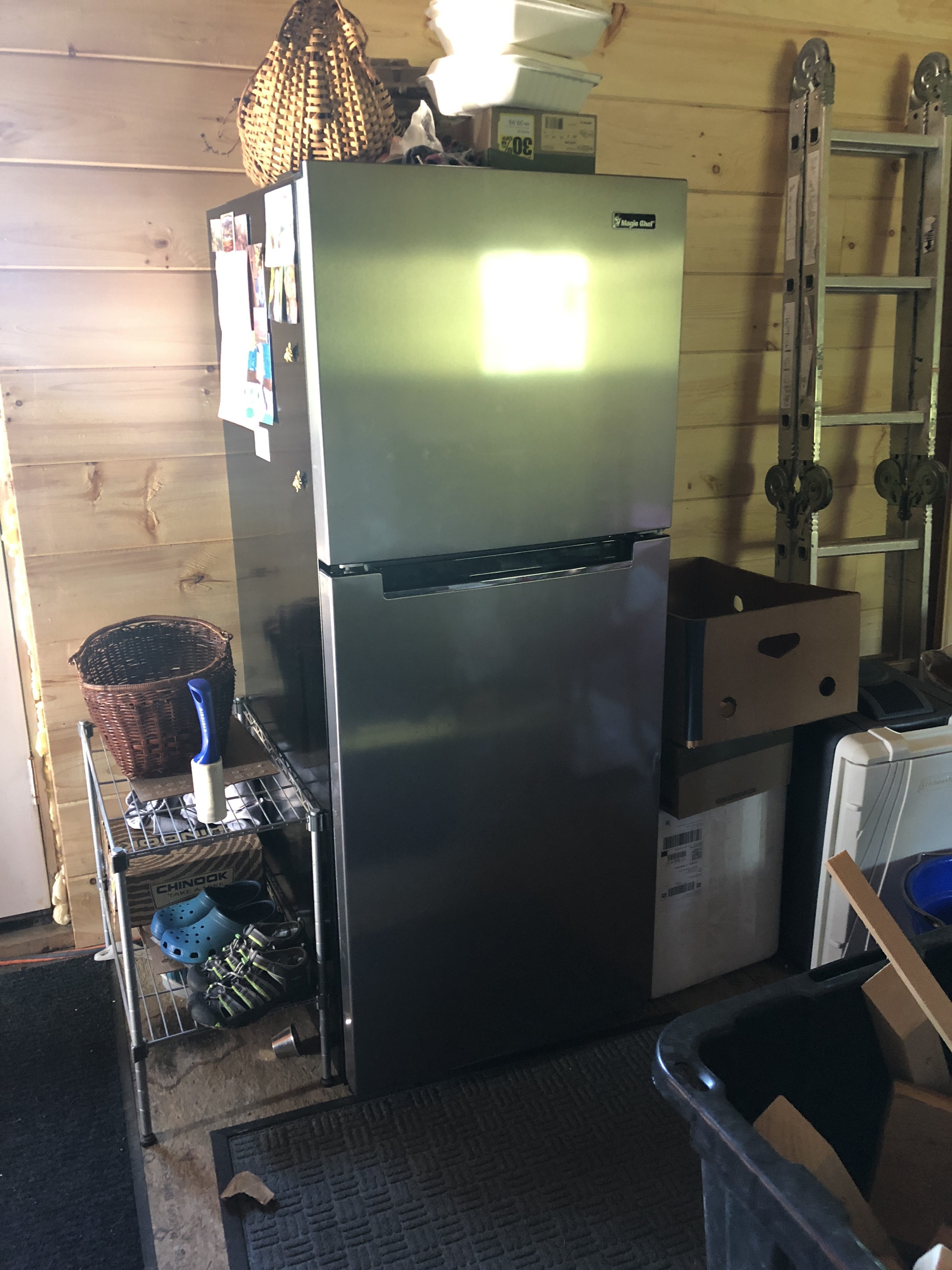
I added 2 batteries, the fridge is a power hog.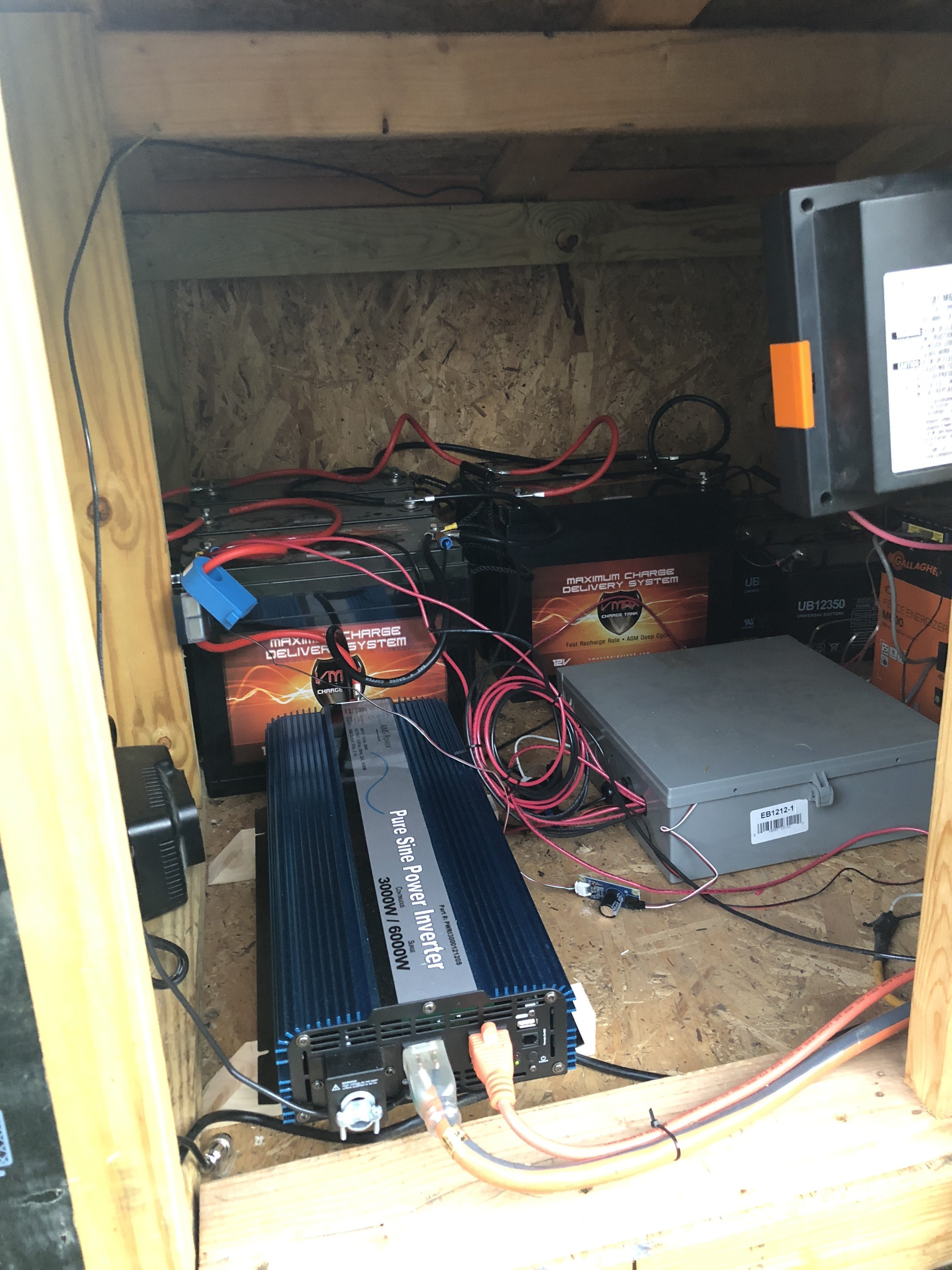
Oh and I used the opportunity to revamp the solar monitoring page, mainly I separated the 12VDC circuit from the 110VAC one and recalibrated the sensors.
We’ve been catching up on all the ice cream we missed on (note that we ate plenty in the past 4 years, just not as much as we would like, which is too much) 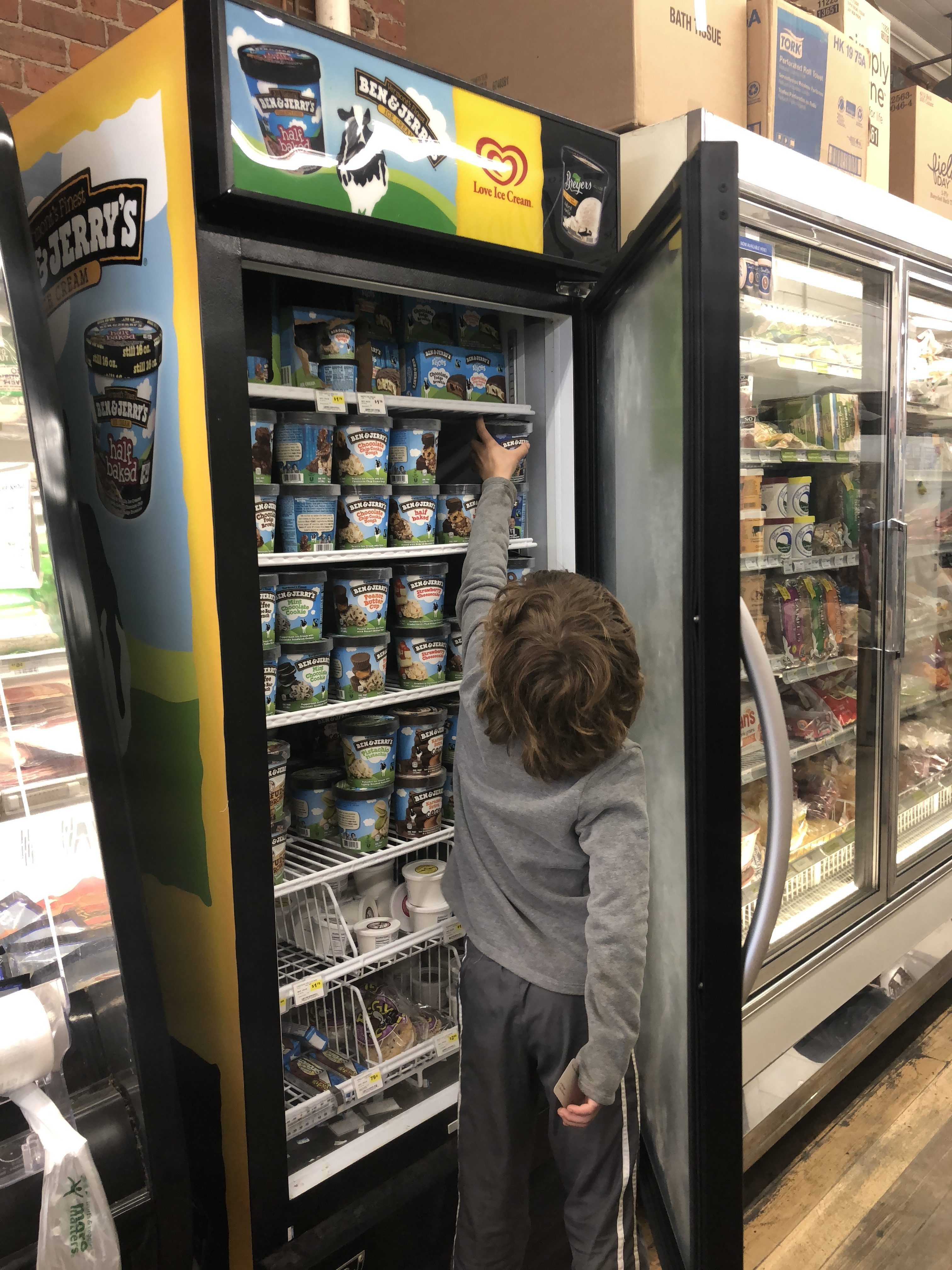
Now, having a fridge is really really nice. I joke that if I had remembered beer was so fresh in it, I would have solared us up enough to power one upon arrival. The reality is that I had to learn how things work and make plenty of mistakes along the way, and that the solar project competes for time against all the other projects.
We did question the need for a fridge for years, we were hoping to change our eating habits to not need one. The truth is that we didn’t (cheese is just too good), and that our eating habits “degraded” immediately after getting one. The fridge is always full and holds a lot of less healthy food we did with less of only a few weeks ago.
Our main concern however, and this may come as a surprise, is the noise that a fridge makes. Our house used to be extremely quiet, it’s something we noted when we moved in, just how eerily quiet the house was. Neither of us had experienced a house this quiet, and it’s something we appreciated. I thought the fridge noise would get on my nerves, but in reality I find it soothing because it makes me think about all the good stuff in there that’s being kept nice and fresh. Did I mention fresh beer is yummy? It looks like 4 years of not having a fridge made me appreciate how nice they are.
Now the coolest thing about this whole deal, is how we’re turning Sun heat into cold. It feels like cheating, and it’s elating. The hotter it gets, the more cold we can generate. How does that even make sense? I’m sure I can understand it but I choose not to, it’s just too good left as universe breaking supernatural magic.
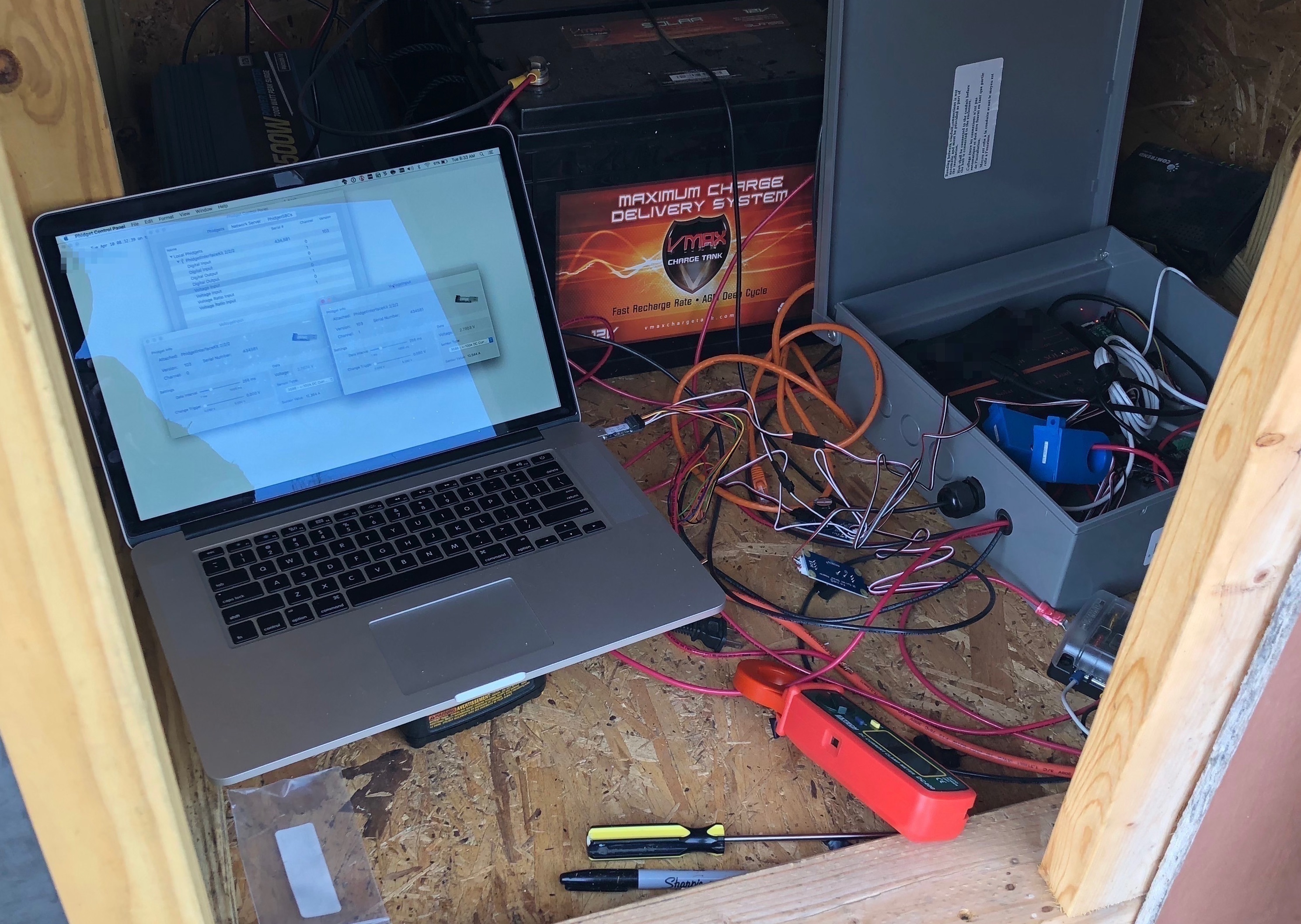
The solar instrumentation has been lacking for a couple of months since the solar panels’ current sensor blew up. It took 2 months because there has been a lot mistakes and learning along the way. It should have been simple, replace the 30A sensor by a 100A one right?
Well it wasn’t. First I ordered the wrong 100A sensor, meant for AC use. Then I had a myriad of issues around calibration.
All these little things I could have picked on their own, but together they conspired to make me thoroughly confused and left me seeking support from the Phidgets forums. I was once more impressed by Phidgets, the help I got was fast and efficient. Phidgets are more expensive but I was proven once more that they are worth every penny. They have many other advantages, I have nothing but good things to say about them.
Calibration, I really need to tidy things up in there
I’ve learned a LOT of lessons with this one. Not the least of which is to be ok with the imperfections of analog data. I’m a discrete data type of guy, it doesn’t come naturally to accept skews & variations.
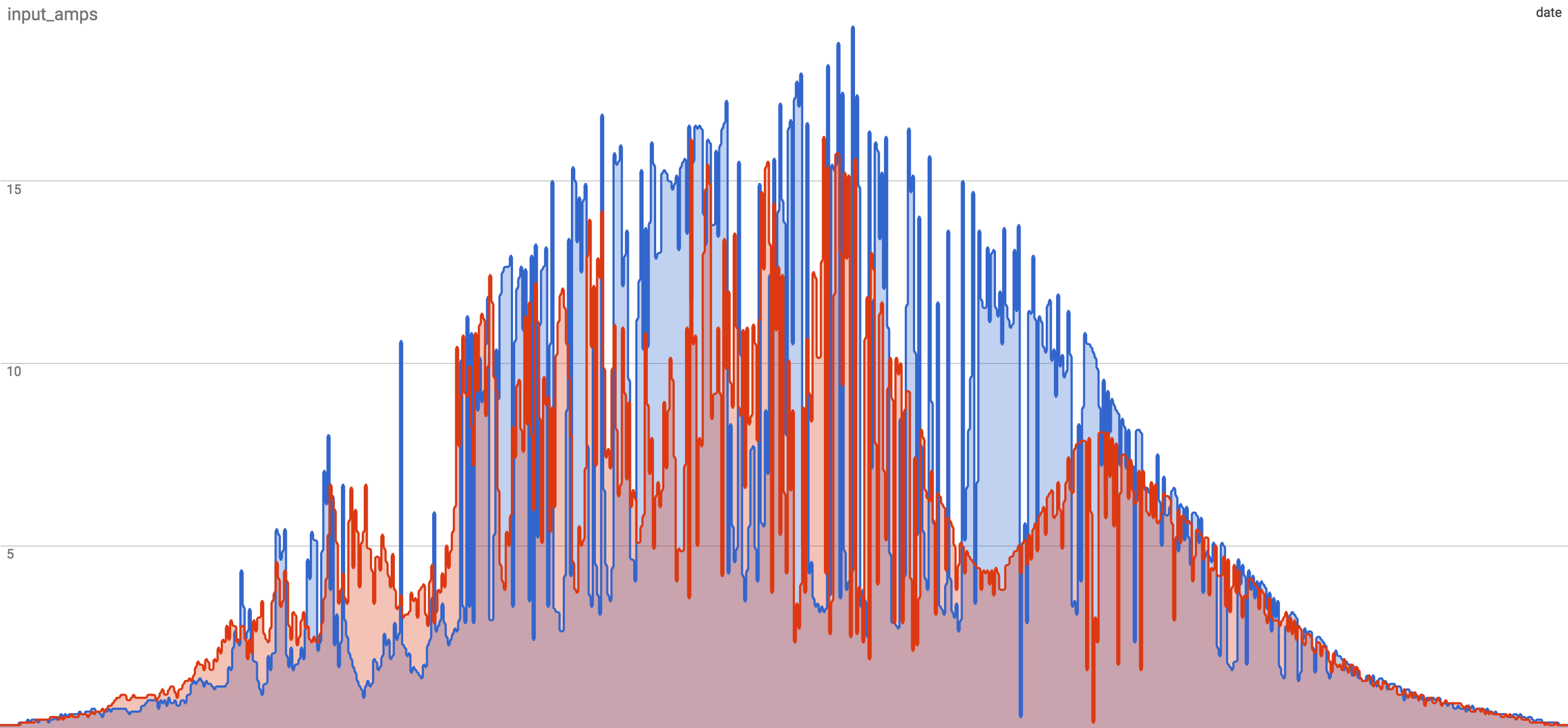
I always wondered why the solar array never produced more than 30A, especially after I added 3 more panels to it. Well, I got my answer yesterday when the array took an unexpected dive.
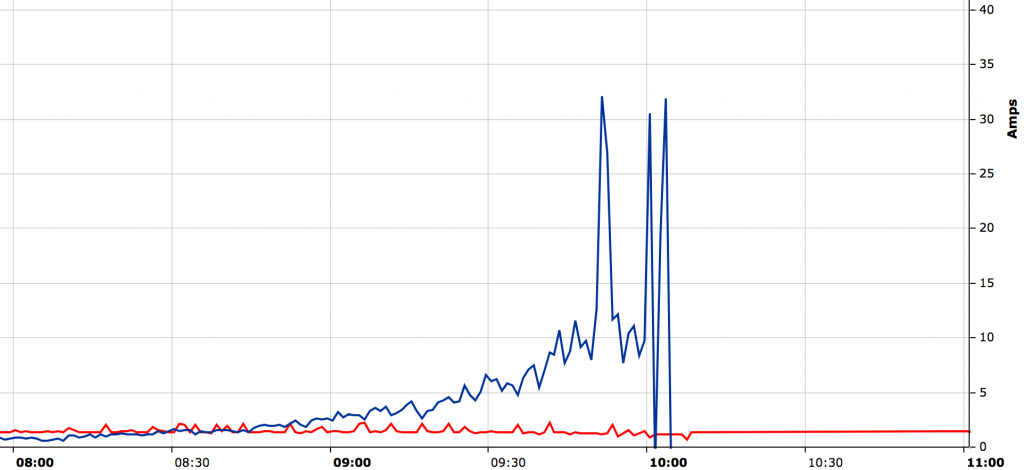
I had forgotten that the amperage sensors I got back in 2015 are only rated for 30 Amps, way overkill at the time :). So it’s entirely possible the array was producing more and I simply wasn’t able to “see” it. Also, the extra panels pushed the sensor over the edge and fried it.
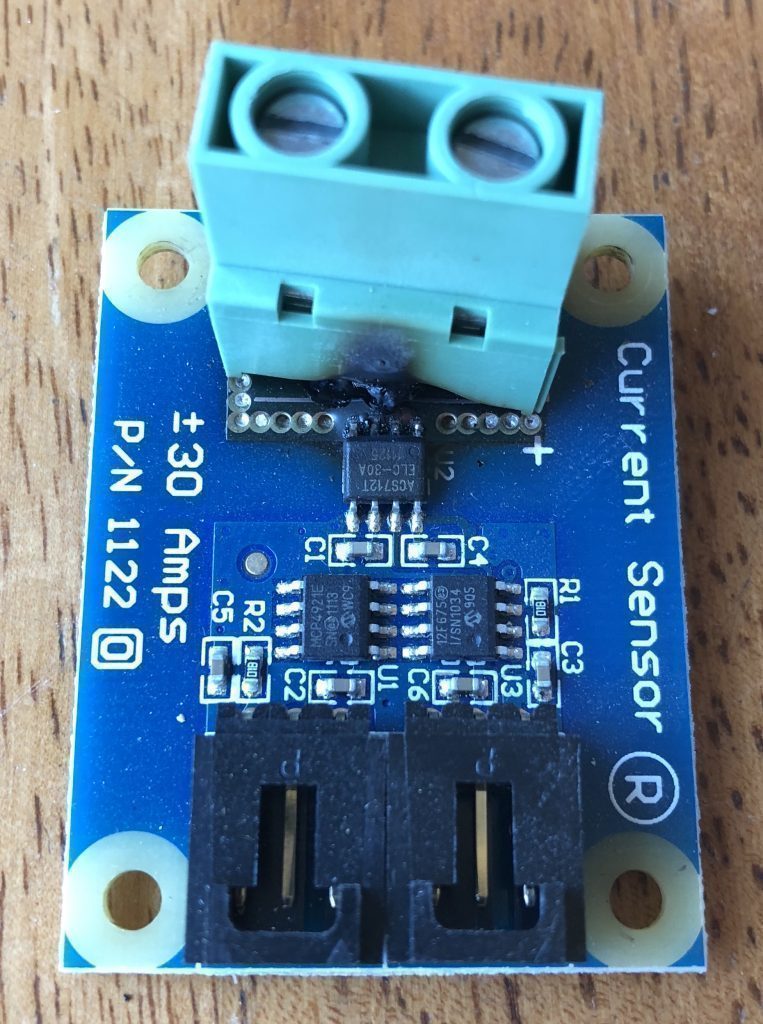
I put in the order for new sensors rated for 100A, it will be interesting to see what the graphs look like. Their design also makes it so if they fail, the production won’t be impacted because they aren’t part of the circuit.
It’s surprisingly difficult to find such sensors rated for high amperage. Phidgets are expensive but they pretty much have the only industrial IOT sensors. In my experience they are robust and easy to deploy thanks to great documentation & code samples.
Another Winter another solar upgrade. Short overcast days are good at exposing a lower limit. After having lost power a couple of days it was time for an upgrade. The house is growing and so it our consumption, especially on the Summer months when we get used to abundant electricity.

Bringing the panels on site, I always said my son would make a great draft horse.


I’m becoming good at building in the cold, my fingers are not thanking me though.

All I need to do now is prop it off the ground and anchor it for heavy winds. 
I like this frame, it takes 6 2x4x8 and this is the only scrap lumber left.
I did some quick back of the envelope math and so far our setup costed about as much as what we would have paid for grid electricity these past 2 and a half years. Seems like it costs about as much to learn how to fish than it does to buy fish, at least at the beginning. We have now entered the gravy zone.
in blue, the curve for a normal day, in red, the moon gets in the way.
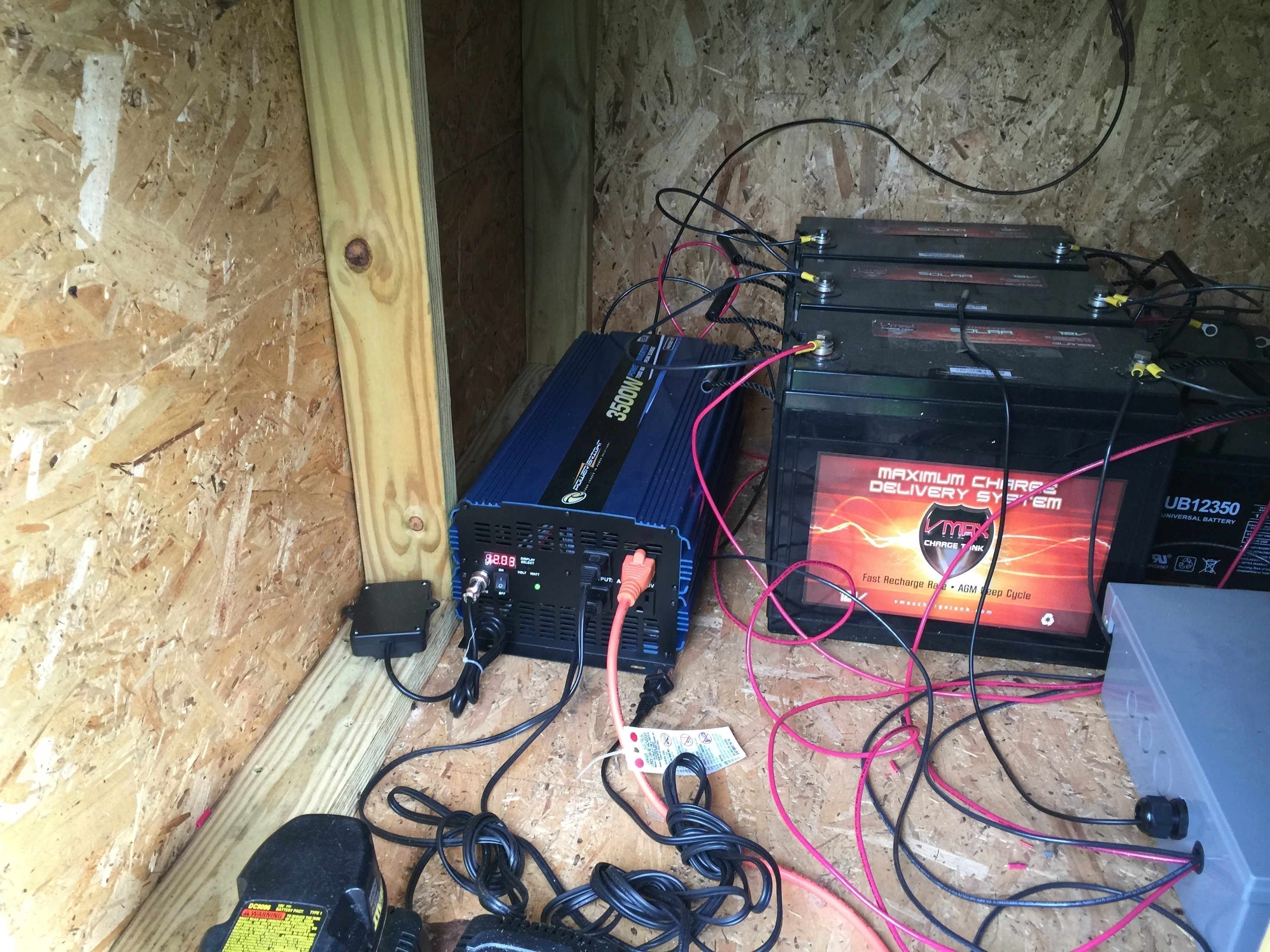
The old inverter I bought second hand for $20 bit the dust. In part due to my lack of cable strain relief which created contact between ground and negative, oops :\ lessons learned. I bought this new guy which works so much better I think the old one was on the way out anyway. I especially love the fact it comes with a remote start/stop. Since we rarely use 110AC and the solar shed is 50′ from the house, it’s perfect to remove phantom loads. It’s not like we remember to ever turn it off, but we can 🙂
but I didn’t think about the chimney 🙂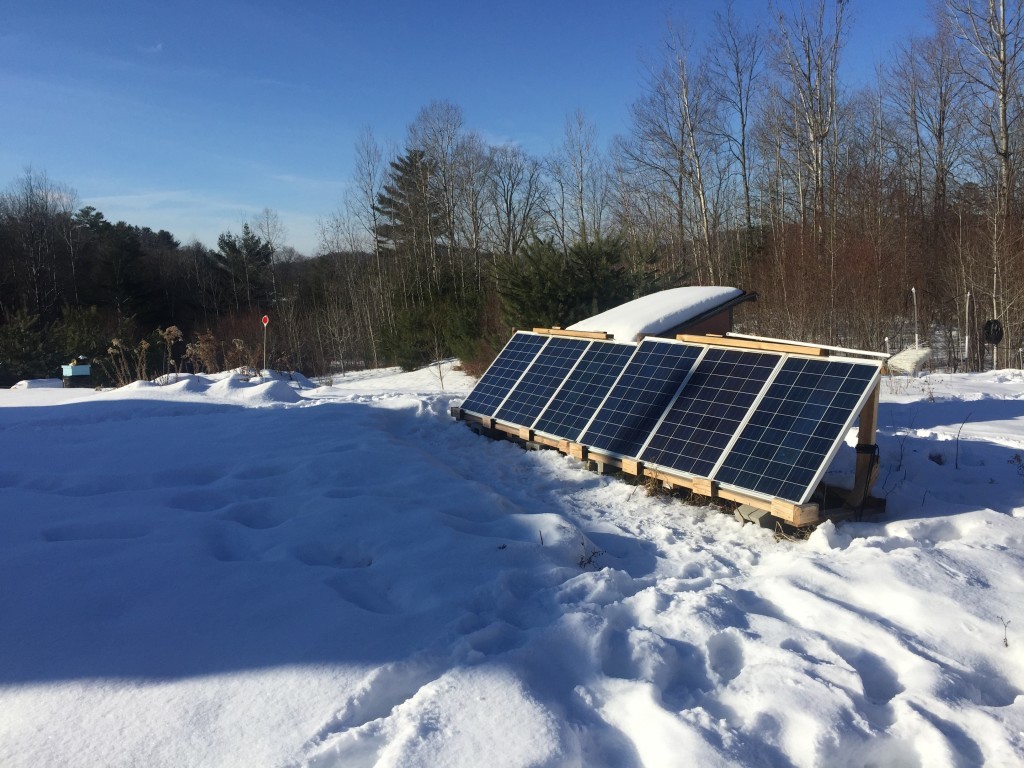

We just upgraded our batteries from 3 * 35Ah lead acid (right) to 3 * 155Ah deep cycle AGM (left). The difference is like night and day; pun very much intended. These bears weight 90 lb each. We added lights in the house and are able to make it through several overcast days without loosing power. I still need to wire in another charge controller and clean up the mess of wires in the solar shed. The old system will get re-purposed for raspberry pi instrumentation around the homestead.