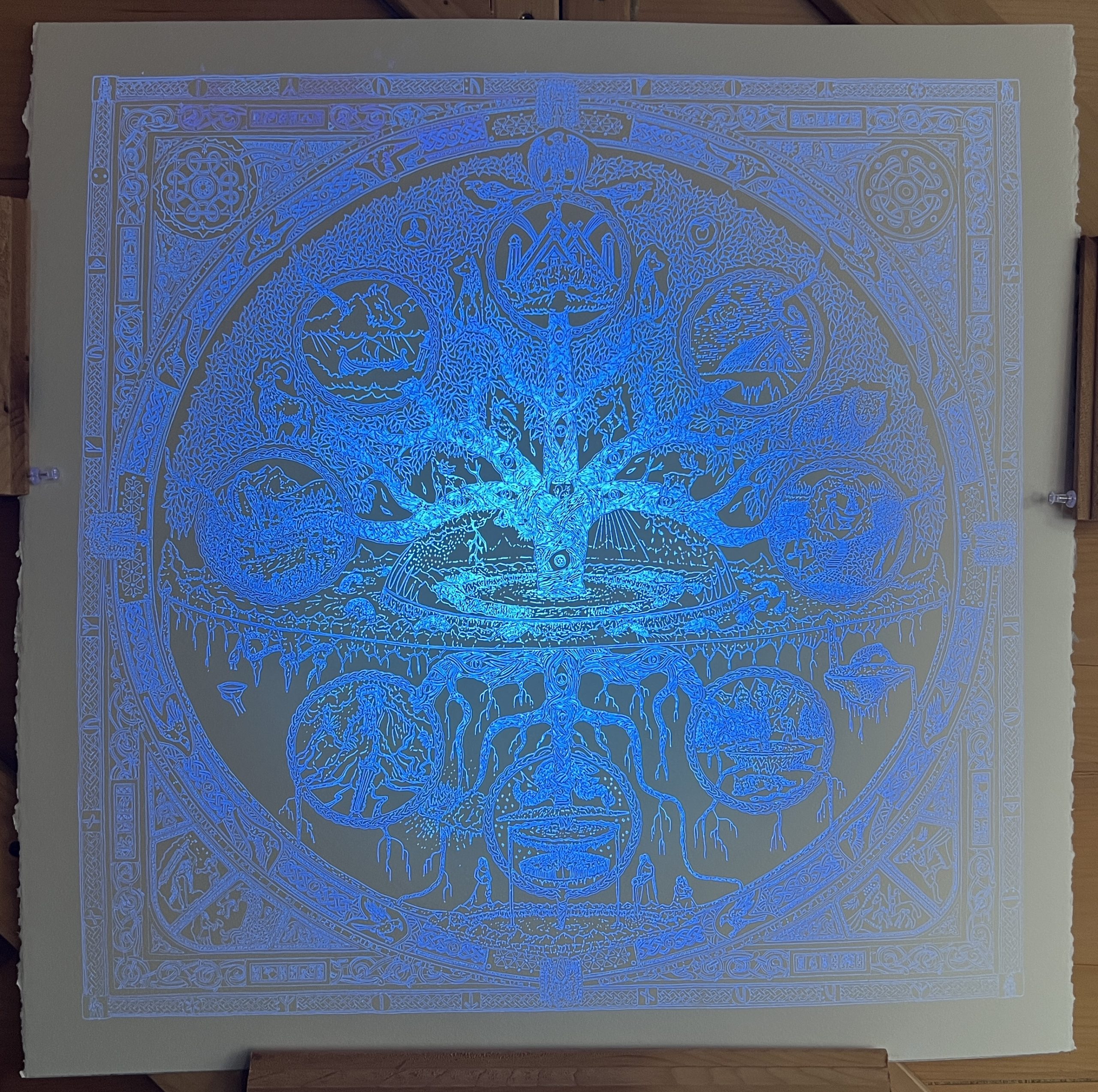
Philip from Germany got in touch to tell me about a cool project he had seen that involved photoluminescent paper. He thought maybe PlottyBot could so something with it, and maybe it could, but not fast enough I thought. I knew exactly what I wanted to do with it though, with the PlottyBot software stack, but a different machine. I love that people get in touch to show me cool things. I’ve been working on plotters for years now, and in some sense it felt like I had turned every stone. Out of nowhere Philip got in touch and steered me toward a whole new area of exploration. Of course one can buy glow-in-the-dark paper, of course I can shoot lasers at it, of course all the algorithms I’ve been working on these past years lend themselves to this new endeavor. Well, with some tweaking :).
It was a real struggle to get Trinamic drivers working on a Pi, but I wanted to step up my motor stepping game. Once I figured it out, holy shit do they work! There’s much else to talk about here, but this isn’t the point of this post, I just want to capture the miletone that is shooting lasers super fast at photoluminescent paper. I still haven’t wrapped my mind around what this all means.
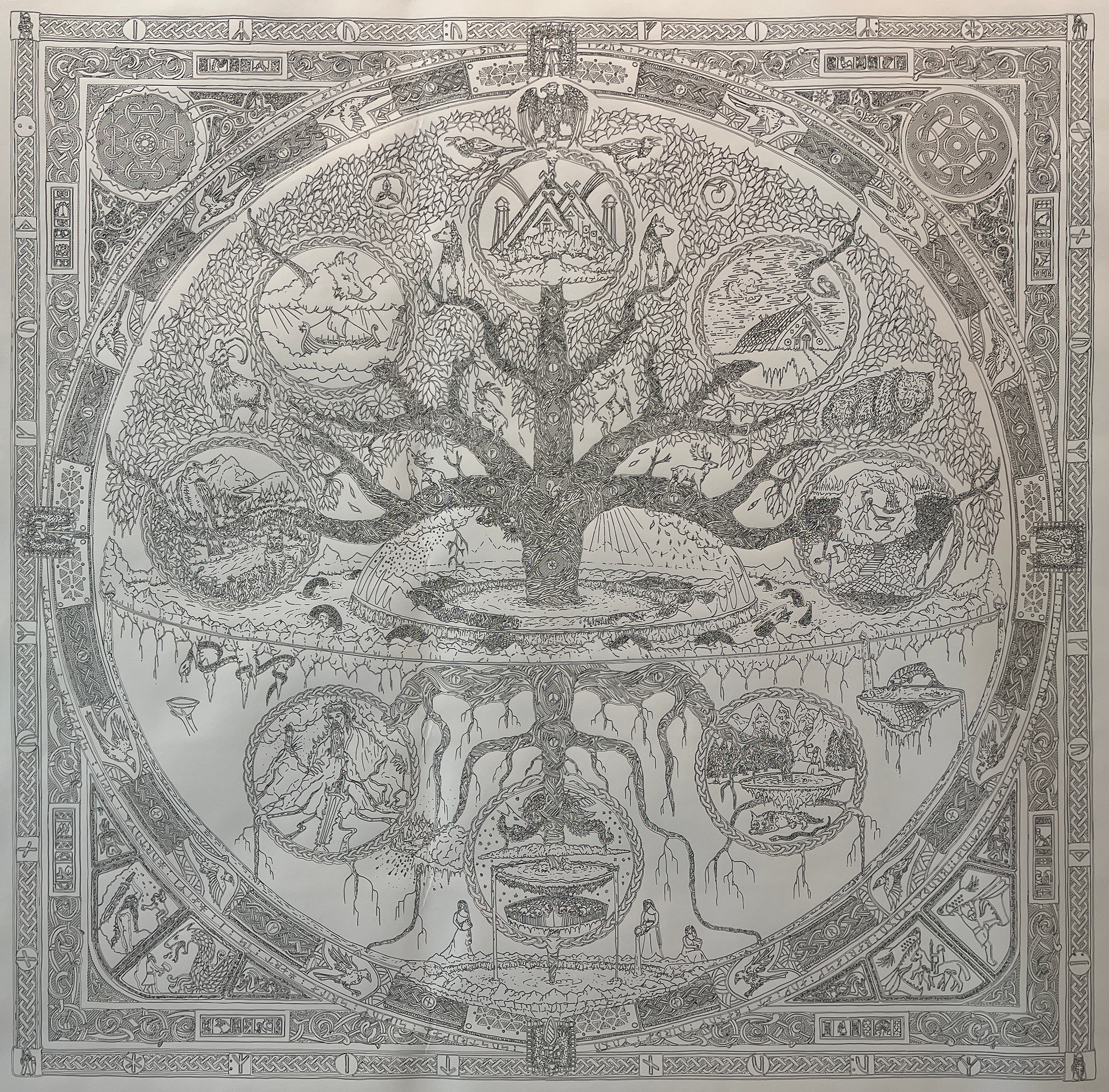
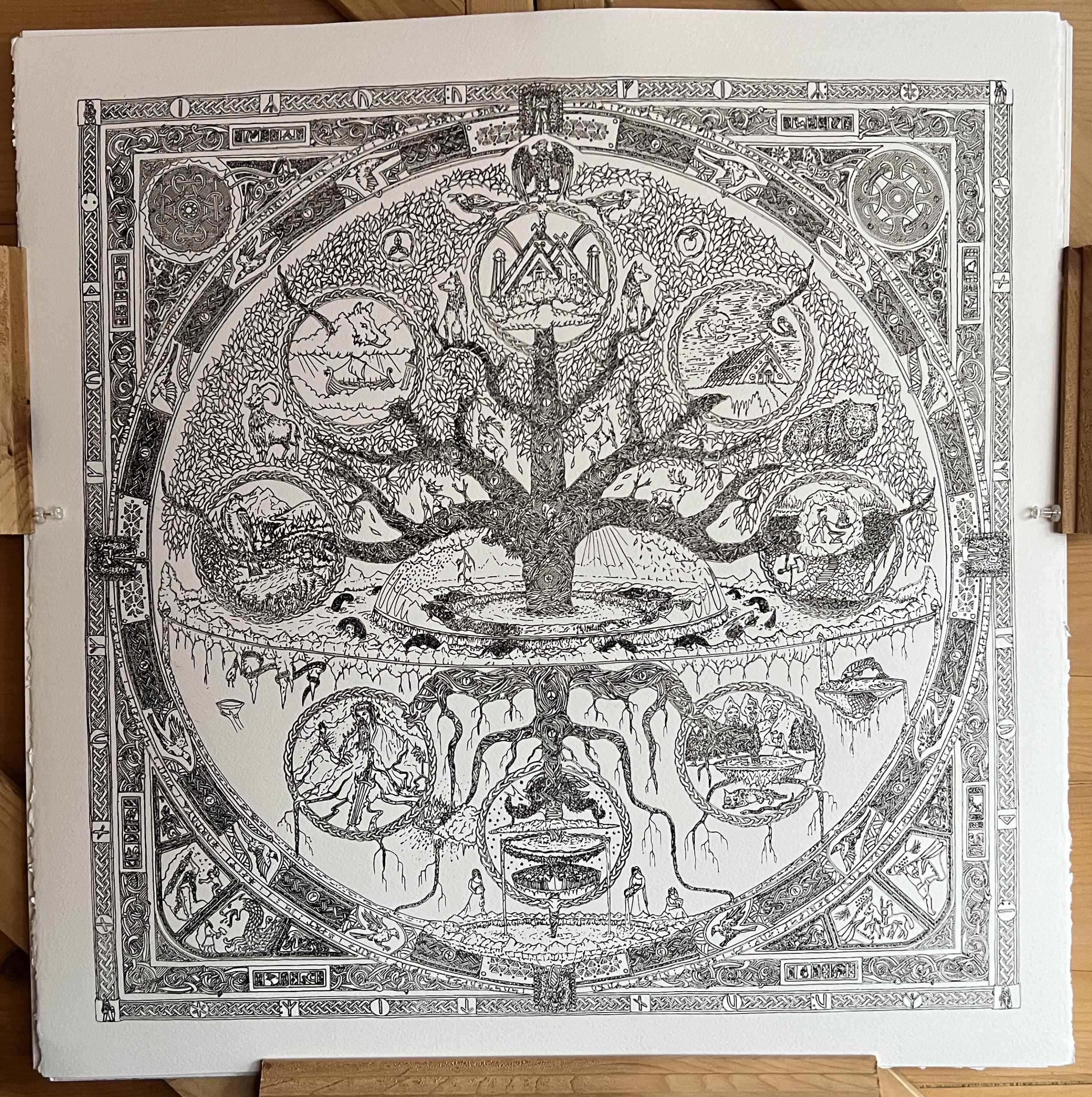
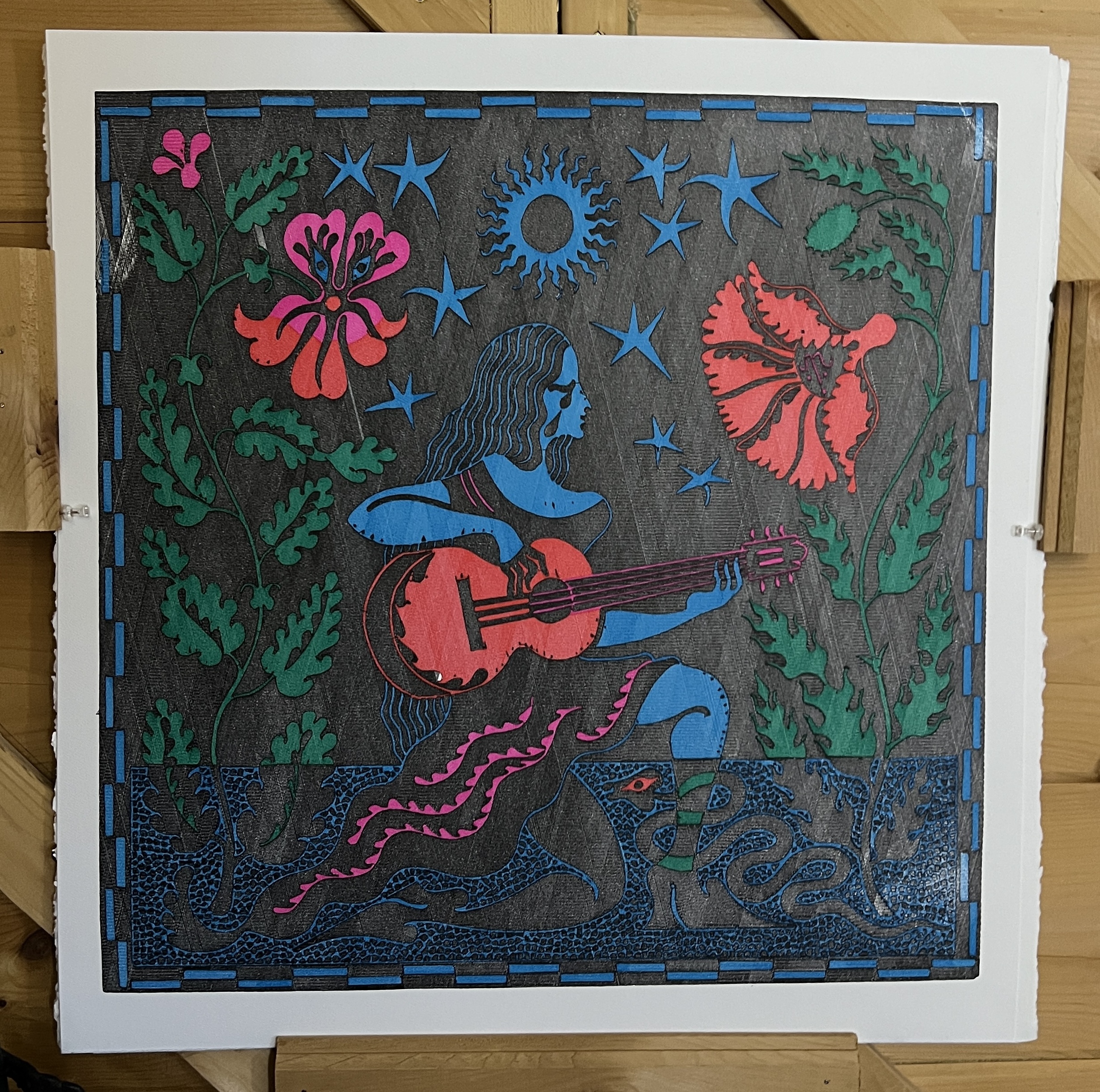
I often contact artists to see if they’d like to do something public on the big plotter, and I’m often met with silence :). Sometimes though, I meet the rare characters who are completely fine doing something cool just because it’s cool, new, and takes their art in another dimension, oh and by the way there’s $0 to be made for either of us. I appreciate disinterested people, and Irish artist Patrick Boullier is such a person. He kindly provided a high resolution scan of his amazing piece: Runestone of Memory so I could try to turn that into penstrokes for the giant plotter. After several trials and help from Vectorizer.ai (top of the line for SVG tracing), I got somewhere we both felt was good, and so it ran on the big plotter for a week.
As is routine, the public reveal was preceded by several smaller scale trials.
This is an awesome piece on Norse mythology riddled with symbolism. I highly recommend reading the explanation of some of it (scroll down some).
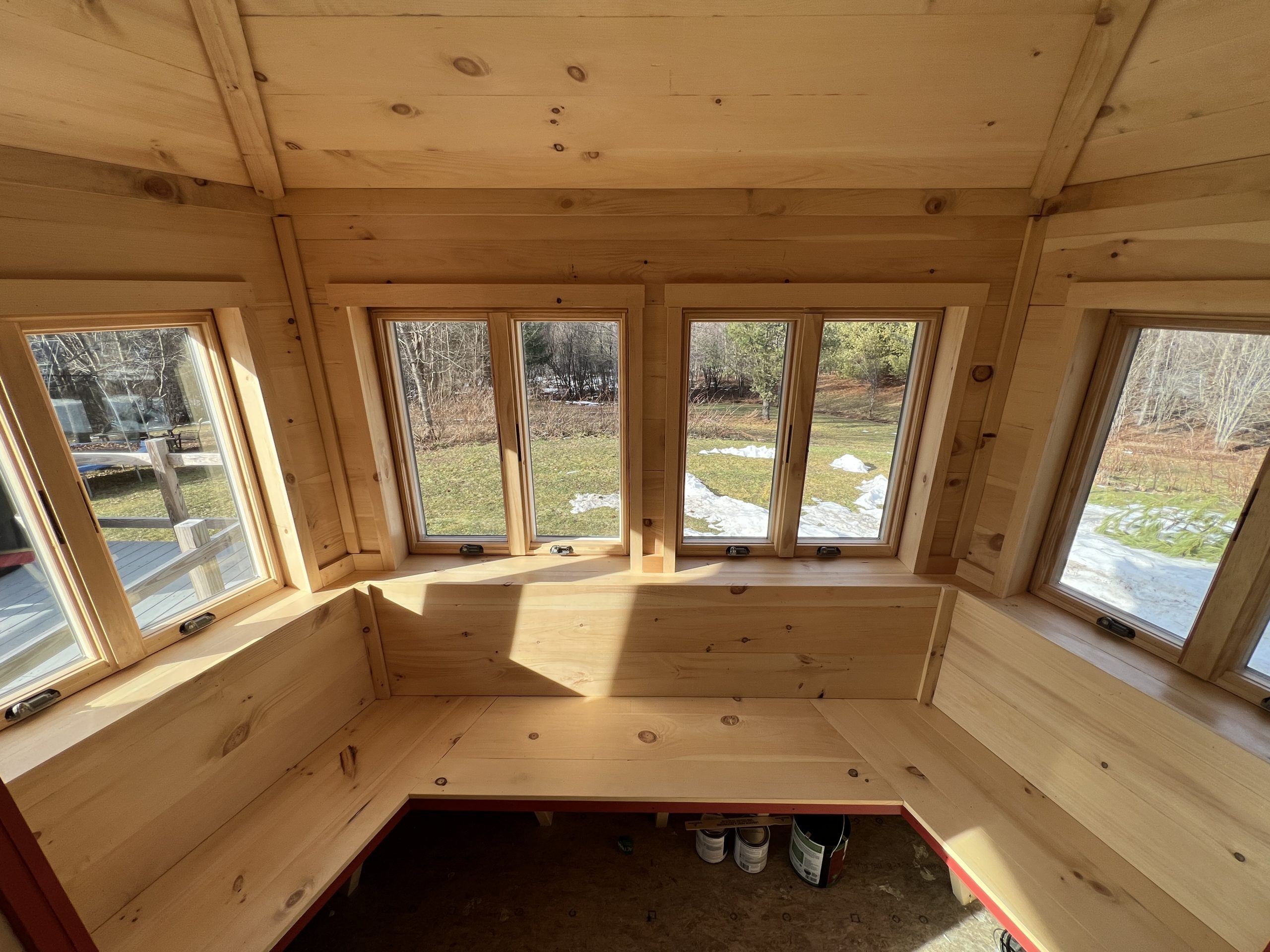
We finally have the quaintest place to eat and hang out in the kitchen. It has the intimacy of a restaurant booth, and we’re surrounded by windows showing nature.
It’s not completely finished, but it’s usable. We still need to come up with a table which embraces the peculiar shapes of this space.
The new stove does this cool thing when you engage the secondary combustion where the flames comes from the top rather than the logs at the bottom. It’s totally weird and I’m glad they gave us a heads up about it.
It was a great plot up until the massive cross-hatch of doom that was the black layer which took days and didn’t particularly enhance anything. Maybe it should start with black paper.
Disclaimer #1: I am neither a linguist nor a historian.
Disclaimer #2: nothing here about national pride of any kind.
Warning: wall of text, yes it’s one of those :).
As a kid learning English in French schools several decades ago, a simple fact about the language was never brought up once. We all learned complex new words, and because they were spelled a bit different, and they were pronounced oddly, we didn’t recognize them for what they were: French words we already knew.
The story goes something like this: the Vikings (North Men) settle Normandy and assimilate local culture & language. Power vacuum in England, Battle of Hastings, and the Normans find themselves the ruling class of England.
And from this we get the well known noble/servant language separation we’ve heard a thousand times: pork/pig, beef/cow, mutton/sheep, venison/deer. What took me much longer to realize however, is how deeply the languages are intertwined to this day, almost a thousand years later. This entanglement goes much further than a little factoid about animal & food names being class based.
To illustrate, it’s worth mentioning that on average a good 30% of English is French. Pick up a random article online and you’ll be able to map about 30% of the words to French origins. That without many etymological convolutions, if any at all.
Here’s a random, non-cherry-picked article article from the local Herald, with French word highlighted:
Largeanimalveterinarians have played an importantrole in the lives of farmers and horse handlers keeping animals healthy and being there through sickness and crisis.
I feel blessed to know two specialveterinarians whose careers have spanned 40+ years in central Vermont.
Tom Stuwe and Will Barry both establishedpractices around the same time with their own styles, techniques, and stories. These veterinarians have stood by so many in the farmingcommunity, through the thick and thin. With a sick animal weighing a thousand pounds or better, veterinarians are nothing short of heroes.
These two extraordinaryveterinarians have recentlyretired.
These two vets to write about as they hold a specialplace in my heart. They are not only farmacquaintances, they have also become friends over the years.
The good news is that there are a handful of new largeanimalveterinarians that are starting up practices in central Vermont so our animals won’t be left without care.
What makes this exercise tricky is that some of these words come straight from Latin, and I won’t do a good job at distinguishing between the 2. As I said, I’m not a linguist. The fact remains that the English of today is the result of a large assimilation of language into Old English. Sometimes the same word are imported twice, these words doubly borrowed often take a slight nuance: take warranty and guarantee. Normans used the W sound where later rulers from central France used the Gu sound in its place. That is in fact how we got wasp, warrior, and William from guespe, guerrier, and Guillaume respectively. But I digress, it’s easy to considering how languages are the accumulation of a million cool little stories.
Cohabitation
Where languages often borrow from others to fill a gap, this particular linguistic assimilation resulted in both sides (French and Germanic) coexisting today within English. There is a fairly clear Venn diagram of words from either side, and most fascinating is where they overlap. French words often have a Germanic counter part, but depending on the register of language, one or the other will be used. And as with pork & beef, the higher the register, the Frencher the word. In all the examples I could find, there simply seems to be more gravity to the French alternative. Here are a few examples I’ve compiled over time. It’s by no means an exhaustive list, just what I stumbled upon:
Germanic
French
business
occupation
wise
sage
woods
forest
freedom
liberty
dark
somber
underground
subterranean
landscaping
terraforming
wide
large
work
labor
fight
combat
snake
serpent
build
construct
lift
elevate
necklace
pendant
disbelief
incredulity
maze
labyrinth
barn
grange
foreseeable
previsible
overseer
supervisor
hindsight
retrospect
folder
directory
in love
enamored
hearable
audible
deep
profound
luck
chance
meaning
sense
answer
response
understand
comprehend
thoughtful
pensive
answer
response
child
infant
outside
exterior
road
route
building
construction
body
corps
top
summit
by hand
manually
strength
force
fall
autumn
undo
defeat
flood
inundate
allow
permit
seek
search
teenage
adolescent
gift
present
focus
concentration
king
monarch
guilty
culpable
shake
tremble
sing
chant
start
commence
instead
in lieu
maze
labyrinth
overcome
surpass
whisper
murmur
trip
voyage
Both sides coexist and are perfectly usable, but one side will be preferred depending on the gravity level you seek. To illustrate this, I will say that landscaping is when you dig a hole in your yard, and terraforming is when you shape another planet for colonization. Both amount to a shovel in the ground, but one involves interstellar travel and the other your backyard and a beer. We can also say that the administration regimenting work is the department of labor. Or that you raise a barn but you elevate consciousness. In all these examples, you could swap the Germanic and French words for they are functionally equivalent, but the French version just seems to have more importance imbued in it.
As a fun exercise, to further illustrate, I tried to “translate” movie titles from their original titles, to their “Germanic English” counter parts. Can you imagine if:
Star Wars, the Phantom Menace was in fact called Star Wars, the Ghost Threat
sounds silly doesn’t it? Yet the meaning is exactly the same.
Or if:
E.T. The Extra Terrestrial was called O.E. The Outer Earther
Although this later example shows the limits of these alternate words. They might exist and be perfectly usable but they just sound too “off”, their meaning might have shifted to beyond usability as a drop-in replacement. You wouldn’t call “Gone with the Wind”“Departed with the Vent”. I mean you could, but that particular mapping yields a meaning different not just in gravity level. You can kind of see how gone is related to departed, and wind to vent, in fact those would be translations into French today, but in English they have shifted a bit.
Make English Great Encore (Anglish)
There exists a small movement to clean up English to only use Germanic origin words, and even push words which don’t currently exist into English. For example Vocabulary could become Wordstock, and Solar Panel could be Sun Board. I can’t say I’d be opposed to it, it was honestly a bit disappointing to go through great effort to master a language only to realize it was in retrospect quite close to your native tongue. And in general I appreciate the richness of diversity. Alas, languages tend to evolve in spite of conscious efforts to shape them. I do find myself picking more carefully between the 2 flavors when they are both available. I love English and have a penchant for words rooted in Old English, from my non-native perspective they convey more culture and history from beyond 1066, and the English language is my privileged view into that.
For example, I find it fascinating to find in language artifacts of how a culture sees the world. When you take the words happy, perhaps, mishap and happen, one can see in “hap” a deeper notion of chance. One which can be used to describe joy, potentiality, bad luck, and something coming to pass. I can kind of see it when I think about it, but to an Old English speaker, there was something more obvious there about how they interpreted the world.
Another great example that is challenging to a learner is the word bear. The many ways it can be used seems to indicate a world view where a baby being born is the same concept as bearing (carrying/wearing) something. I see it, your mom carried you around and this is now over so you’ve been born. But what kind of world view does it take to relate the deep human experience of childbirth, with the menial task of carrying something? I speculate here, but I think it’s a world in which people carried a lot more stuff by hand: wood, water, supplies. Carrying was important, omnipresent, manual, and closer in hardship to pregnancies than it is today. I think it’s fascinating how language today reflects a human experience from the depths of time.
Lastly, and because I just used it in the previous paragraph, the word wear links the notion of use with that of decay. You are ever reminded by language that the sheer act of wearing your favorite shirt implies its earlier demise. And again I find myself thinking of the ancient world in which these 2 notions are linked, likely one with more scarcity.
Translating without Learning
Here’s are a few tricks to translate French into English today without knowing a word of it
replace é by s:
état – state
écureuil – squirrel
éponge – sponge
étranger – stranger
épice – spice
étoile – star (a bit more far fetched)
épinard – spinach (a bit more far fetched)
add an s after a ˆ
tempête – tempest
hôtesse – hostess
maître – master
coût – cost
arrête – arrest
hôpital – hospital
pâte – paste
huîstre – oyster
replace gu with w
guerre – war
guêpe – wasp
guardien – warden
replace ch with c
chat – cat
chapeau – cap
char – car
replace eu with o
majeur – major
interieur – interior
I’m sure there’s many more such tricks & examples, to me it was mind boggling to realize that a large fraction of English had little to no daylight with French. It’s a fact hidden in plain sight.
The Probabilities of it All
Well, I’m reaching the end of my observations here. I actually created this post several years ago when I first realized how far this entanglement went. I know this realization is not news to many, but it arrived late here, and I loved exploring it from the completely non-academic perspective of some dude going about his daily life in the U.S.. So I added to this post over the years as I ran into little nuggets of knowledge on the subject. And I am eager to put it behind me, I feel like I’ve gone around and turned the stones I wanted to turn. Particularly, I was interested in doing computation on corpora of English to answer several questions:
Do English & French converge, diverge or remain stable overtime and until today?
Can we see both poles (Germanic & French) in the language and how do they progress over time? Is a statistical loss for a pole a gain for the other? Do world events bring out one side over the other?
If we can associate “gravity” to the Frencher turns of phrases, can we also associate context (science, religion, spoken)? More slippery, can we associate ideology? Would a speech from a more socialist leaning person be statistically closer to French?
I launched into it and threw a lot at it. I used my Markov chain models as a statistical model to compare against. Given a previously analyzed probability distribution letter for French, Dutch, or German, I found various corpora of English to compare against them, only to find mitigated results… First it’s been harder than I thought to find decent corpora to analyze. I think I need more data, and so if you are still reading and have any recommendations for a nice clean corpus of data of a lot of English over a long time, please drop me a note. Another challenge has been that my previously analyzed probability distributions of languages were done on modern languages which included many poison pills of exchanged words ruining statistics. So I instead used Old French, Old Norse and Old English as my points of reference to compare against, I figured these would be “cleaner” from these exchanges. There again maybe what I really need is a good corpus of data from which I could parse word origin to remove these poison pills from my statistical models. This introduced an interesting concept which is obvious in retrospect:
English is evolving away from its Old self
The data analyzed above are news articles from the sample provided by COHA (I can’t justify spending the money on the full thing). On the vertical axis is a proximity grade that is of an arbitrary unit so the number isn’t meaningful except when related.
I suppose I should have expected English to keep evolving over time, but this downward progression makes for a more complex baseline.
Of course it is also evolving away from Old French (red) and Old Norse (orange):
So far we’ve learned nothing, and I don’t see many peaks and dips I could map to world events. But on the analysis of the U.S. State of the Union speeches you can see world wars, and it’s easy to speculate that concerns and word choices would be different in a time of war. I like the stability of this corpus, but I don’t like that a single president and his language predispositions could be single-handedly responsible for a peak or a dip.
I do wonder why the post WWI era seems more unstable than the pre, more speculation here but maybe that is a sign of an accelerating world. What we don’t find are zero sum swings between a Germanic and a French pole so that theory I had doesn’t work, but I’m honestly not sure why.
Lastly for ideology and context, I analyzed a few subreddits to give them that same grade against Old English, Old French and Old Norse. There does seem to be some correlation but it too isn’t as telling as I thought it might be.
All in all this statistical analysis isn’t as revelatory as I thought it would be which is a bit of a disappointment given how much I tried. Oh well, It still shows a couple of curious artifacts.
In conclusion, because it does feel like such a long post should be wrapped up with a paragraph starting with “in conclusion”, I will simply say that I’ve loved my journey into linguistics and culture through learning English. It is a beautiful language, and clearly the Lingua Franca of its time (double entendre very much intended).