Because I always end up wasting 20 minutes looking it up.
tcpdump -i ethX -s 0 -w traffic.pcap
Because I always end up wasting 20 minutes looking it up.
tcpdump -i ethX -s 0 -w traffic.pcap
Not all cron jobs are created equal, and some of them can afford to fail sporadically before we need to worry about them. Maybe they rely on a third party server, and we don’t want the occasional fail to pollute our inbox.
Here is a little cron job wrapper I created that will suppress stderr but keeps track of the job’s returned exit codes. Above a certain threshold of consecutive abnormal exits it doesn’t suppress stderr anymore.
# if the counter file doesn't already exist we create/initialize it
if [ ! -f /tmp/counter_ri7g3 ] ;
then
    echo 0 > /tmp/counter_ri7g3 ;
fi ;

# we pull the current counter
counter=`cat /tmp/counter_ri7g3` ;

# if the counter is still small, we send stderr to /dev/null
if [ $counter -lt 5 ] ;
then
    $1 > /dev/null 2>&1 ;
# otherwise stderr will follow its normal path and find its way to email
else
    $1 > /dev/null ;
fi ;

# lastly if running the $1 resulted in an abnormal exit, the counter is incremented
if [ ! $? = 0 ] ;
then
    counter=`cat /tmp/counter_ri7g3` ;
    echo "$counter+1" | bc > /tmp/counter_ri7g3 ;
# and if $1 exited normally, we reset the counter
else
    echo 0 > /tmp/counter_ri7g3 ;
fi ;
a cron entry calling it looks as such:
30 * * * * root /usr/local/bin/cron_wrapper "/path/to/script arg_1 arg_2"
ipv6_surface_analyzer_1.0.tar.gz
tested on Ubuntu 11.10 64b
(actual ips obfuscated)
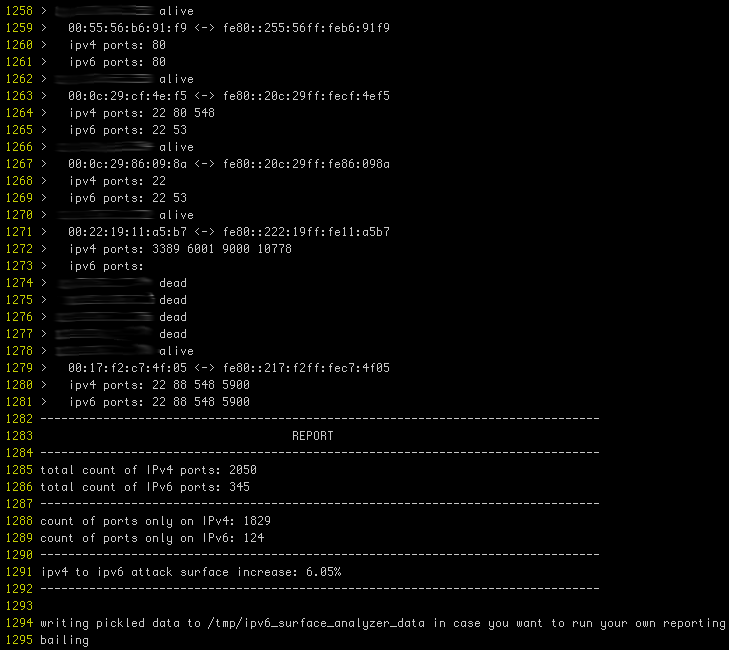
With more devices coming IPv6 ready out of the box, a shadow network is emerging that nobody is paying attention to.
There’s Joe sysadmin, configuring a tight firewall for this new server, default deny, very restrictive & all. This is great but did he realize that there is nothing in front of IPv6? We are used to setting up iptables, ipfw, et cetera. Unfortunately ip6tables & ip6fw too often get forgotten.
With IPv4, a device was manually configured or wasn’t configured until it got an address from DHCP. With IPv6 a device that is not manually configured will hop on the network with a link-local address and try to further discover its settings. In fact, IPv6 reserves a range of addresses for network discovery, these link-local addresses are based on the device’s mac address.
Here is what ipv6_surface_analyzer.py does:
The purpose of which is to establish by how much your attack surface is augmented by link-local IPv6.
This threat threat is somewhat mitigated by its local nature and there are 2 reasons why:
Local as it may be, having a shadow network providing a way to circumvent firewalls is quite risky.